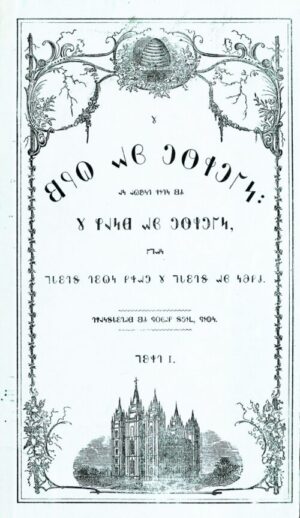

Brigham Young, who allegedly declared “this is the place” when his pioneer company caught sight of Salt Lake Valley, also tried to pioneer a phonetic font.
Earlier this month bibliophiles in San Francisco gathered for a lecture about the Deseret alphabet by Brigham Young University’s Greg Seppi at the Book Club of California.
Besides moving his flock to the desert, Brigham Young sent delegations to Saint Louis and then New York to promote what’s known as the Deseret Alphabet, 40-odd symbols selected to render English words phonetically. And odd symbols they are.
The chief evangelist for the new alphabet entered the One True Church with a footrace. As being the first to-be saint to rush to a river, George Watts won the prize of being the first person baptized into the Mormon Church in England. He also happened to know Pitman shorthand, a set of quick-draw symbols invented a few decades earlier to let scribes jot down speech in real time.
But accurate transcription was not what excited the Prophet of the Lord. Brigham Young was, Seppi told us, less scholarly than Joseph Smith or other Church leaders, and spelling would be much easier with letters that match how words sound. A more logical alphabet would also help an influx of emigrants to Utah learn English and so help a growing population of Saints cohere. (There’s much to be said for this argument, especially in a world without ready access to dictionaries, let alone spellcheck. Benjamin Franklin was a fan of alphabet reform. A famous example of English craziness explains how the word “fish” could be rendered as “ghoti” with the “gh” from “enough,” the “o” from “women,” and the “ti” from “action.” More poignantly Seppi said, nothing drives home how illogical English is like watching a 4-year-old learn to read.)
A new alphabet offered spiritual advantages too. It was a potentialfirst step back toward the pure “Edenic” language corrupted by the tower of Babel. And so, in 1854, Brigham Young decided that the phonetic alphabet should be something created anew rather than drawn from pre-existing alphabets.
Promoting more-logical letters proved to be a logistical nightmare. The wholly unique alphabet lacked the means of production. Saints jury-rigged blocks for printing with gun maintenance tools and wood, but there simply wasn’t any proper type to set.
Undaunted, Brigham Young ordered a font to be both designed and manufactured. A delegation dutifully went to Saint Louis to bring back the punches and matrices. The result was taught in adult literacy classes and some Utah schools. Deseret News ran occasional scripture passages in the alphabet as well.
It wasn’t wildly popular, and the Prophet thought it was ugly. Even Watt was not a fan. In the 1860s, the alphabet was redesigned, and this time the delegation tried for a typeface in New York City – such was the backlog of stuff to be printed, and the stranglehold of publishing industry over the presses, that the delegation struggled to find anyone to take the job.
Ultimately, the team came back with thousands of primers and hundreds of copies of the Book of Mormon in the Young-approved Deseret Alphabet only to face the final, fatal hurdle: no one wanted to buy them. Hardly a fifth of the inventory sold. Sometime in the 1960s, hundreds of pristine century-old primers were discovered in storage at the University of Utah (nee University of Deseret); they’d been all but forgotten.
An alphabet that no one can read, Seppi concluded, just doesn’t make sense in a church so focused on spreading the word.
Interesting post! Personally, I love the peculiar parts of Mormon history. Sad that today’s LDS leaders seem so intent on covering up or distancing themselves from these fascinating bits of their collective past.
Thanks for the info! I was aware of the Deseret Alphabet, but I didn’t really know what the story was.
As Donna says, looking at the CoJCoL-dS today, it’s hard to imagine them doing something like this. But a few hundred years ago, it was all about the newest, coolest, latest ideas — that was a huge draw!
Unfortunately, once these 19th century ideas become enshrined as the word of God, over time the doctrine becomes an embarrassment.