
My brother-in-law came to visit last weekend. As science geeks, we tried to see a shuttle launch while he was here (the launch was canceled 11 minutes before liftoff because of weather – ugh!). On the way to watch the launch we stopped by Deseret Citrus and Cattle Ranch to see the Mormon Church’s ranching operations:
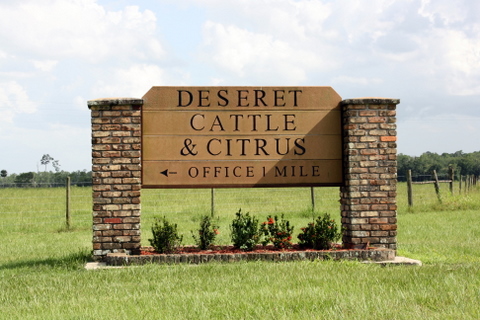
Alas, as former Mormons, we failed to consider that they wouldn’t offer tours on Sunday. But we stopped by the Visitor’s Center anyway and drove around a bit. Here’s the Visitor’s Center:

I knew from the Deseret Ranches’ website and this wikipedia page that the ranch was big, but actually driving around the ranch made me wonder just how big it is. So, I spent a good 10 hours or so trying to see if I could map out just how big the ranch is. After all that time, I realized it was simply too big for me to easily map out by myself. But, the research I did do provided me with some fascinating information.
First off, thanks to a corporation registration website in Florida, I was able to track the name changes of the holding companies for the ranch over the years, eventually finding the current name. It used to be Deseret Properties of Florida, Inc., Deseret Farms, Inc., Deseret Farms Inc., Deseret Ranches of Florida, Inc., Deseret Livestock Company, Deseret Properties of Florida, Inc., Deseret Ranches of Florida, Inc. (1), Deseret Ranches of Florida, Inc. (2), but it is now called Farmland Reserve, Inc.. Once I finally found the current holding company, I was able to visit the property tax appraisers’ websites for the three main counties where the ranch is located: Osceola, Orange, and Brevard. On those sites I found all the property listings of Farmland Reserve, Inc. Here’s a summary of what I found after I added them all up:
| County | Acres | Value |
| Osceola | 182,685.50 | $763,252,812.00 |
| Orange | 64,843.57 | $208,286,252.00 |
| Brevard | 41,559.66 | $12,552,680.00 |
| Hillsborough-FRI | 3,952.94 | $30,145,012.00 |
| Total | 293,041.67 | $1,014,236,756.00 |
Yep, you’re eyes do not deceive you – LDS, Inc. has more than $1 billion in for-profit property in Florida. The acres convert to 457 square miles, or .7% of the State of Florida. I can’t say for certain, but my guess is that LDS, Inc. is the largest landholder in the state behind the government. For comparative purposes, Disney owns 25,000 acres (that’s all of their properties, not just Disney World), or about 1/12th of the land owned by the LDS, Inc. holding company.
To tally all of this information, I actually built a spreadsheet that you’re welcome to download and peruse. I also started drawing the land parcels in Google Earth, but once I realized just how many there were, I decided I just didn’t have the time. I did complete all the land in Orange County and started on the land in Osceola County. If you want to see the maps or, better yet, if you’d like to improve/complete the maps, you can download them here: Orange County, Osceola County. If you do download them and improve them, please send me a copy of the updated versions as I’d like to have them.
As I was searching through these listings, on a whim I decided to see if Farmland Reserve, Inc. owned any property in my county, Hillsborough, FL, which is all the way across the state from Osceola and Brevard Counties. Turns out they do (see above table). That’s in addition to the $12 million owned by “Church of Jesus Christ of Latter Day Saints Corporation”, which is the company that holds the churches. This makes me wonder just how much property Farmland Reserve Inc. owns. I checked a couple additional counties in Florida but didn’t find any more property.
One of the reasons I wanted to visit the ranch is because my aunt and uncle recently completed a mission there (I should have gone while they were there, but never made it). The amazing thing about the fact that they served a mission there is that they did zero proselytizing and they paid to serve their mission. So, what did they do? My uncle was a high school shop teacher. He knows how to build and repair homes. So, they put him to work building the homes and roofing of South Jordan. He’s round 70 years old and was working 12 hour days 6 days a week for 18 months. His wife ran some of the tours and did other odd jobs around the ranch. When I found out that my aunt and uncle were paying for the opportunity to work for Farmland Reserve, Inc., a billion dollar for profit company, I was not very happy. Not only did the LDS Church use tithing money to buy the ranch (I’m assuming, maybe it was profit from some other business venture), but now it makes people pay for the opportunity to make one of their subsidiaries money. How is that at all ethical?
To wit, the obvious question is: How does the billion dollar ranching operation of the LDS Church further its religious aims? Why does a religion need a billion dollar ranch? Anyone?
Finally, all this searching around for property owned by LDS, Inc. led me to realize that we, the MSP community, could probably put together a pretty good estimate of the property holdings of LDS, Inc. (in the US at least) fairly easily if we distributed the work among us. If each person looked up the holdings of LDS, Inc. in their county and put them in a spreadsheet, we could aggregate them and keep a running total of known property value of the LDS religion. It would make a cool little widget for MSP to display. Thoughts?
I find the whole “money” aspect of Mormonism unseemly–from tithing to ranches to malls. I know we live in a world where money is required to achieve just about everything, but still, UNSEEMLY.
It was actually the priority my Bishop and Stake President put on the amount of tithing I was contributing, before my temple wedding, that was one of the earliest alarm bells that went off in my head regarding Mormonism. It was like paying to get to the next level of the gospel. Made me uncomfortable then and makes me mad now. LOL
The whole mission thing to further the financial earnings of the church just boggles the mind.
Wow. This is amazing research. Great work.
The part about your parents’ mission is pretty shocking. You’re right; that doesn’t strike me as ethical at all. I guess the LDS Church figures that if it can’t convert the world, maybe it can buy it. 🙂
After a little poking around on the web, I figured out how to search for corporate data in my state. Plugging in Deseret gives a couple dozen entries, most of them suspended, forfeited, or dissolved. Suspension and forfeiting apparently occur due to a failure to pay taxes or a failure to file the required paperwork. The companies named “Deseret” include telecommunications, farming, mortgage, gift card, and construction companies. Some of these, though, may not be Church-owned. I’ve never done this sort of research before, so I’m really not sure what I’m doing. 😉
We have Farmland Reserve here, too. I’ll have to do some more searching and see if I can find out what their holdings are.
I’m not sure how to find out their holdings here. I can’t figure it out.
Wow! I’d heard that LDS Inc, has huge for-profit land (and business) holdings, but it’s shocking how much it really is.
I assume that (being a religion) they’re exempt from having to report or declare (to the public or anyone) how much the corporation of the president of the CoJCoLDS owns…
Eye-opening (popping?) figures.
It’d be great to see this diary posted widely.
It is too bad you didn’t visit your aunt and uncle while they were there. They might have cleared up some of your questions, if not your cynicism. They might have told you that the beef and agricultural product from these farms is sent to storehouses, where the food is given free to people who need it to live. In other words, it is the backbone of the non-governmental welfare system in the world. I’m not sure how any of this constitutes “for profit.”
Nut that shouldn’t stop anyone from throwing bombs anyway. It would seem a shame to work up all that hate and not be able to share it.
Good to meet you, Rick. I am aware of welfare farms. But I find it implausible that those corporations are welfare farms.
If they were welfare farms then the LDS Church could incorporate them as non-profits and save the property taxes.
Anyways, I would love to know what is actually going on. Unfortunately, there is no way to find out for sure because, unlike many other religions, our church is refusing to open the books.
By the way, Rick, nobody here “hates” the LDS Church, especially, not ProfXM. Some of us do think, however, that the LDS Church would benefit from a little accountability.
Hi Rick,
You’re right that I should have visited when my aunt and uncle were there. They may have been able to explain where the beef went. I doubt it goes to storehouses, exclusively, but I could be wrong.
However, your optimism as to the charitable aims of the operation seems a bit unfounded. The website of the ranches openly admits to selling seashells (http://www.deseretranchflorida.com/r-mining.html) for roadbeds and other industrial uses. Of course, they don’t report their profits from that operation, but I’m guessing they aren’t giving those seashells away as part of their charitable operations. Unless there is some charitable component to seashells of which I am unaware? Are they useful for food storage? Maybe they make nice necklaces for tsunami victims? 😉
They also sell sod (http://www.deseretranchflorida.com/r-sod.html) and timber (http://www.deseretranchflorida.com/r-trees.html) on the ranch, neither of which seems like an ideal candidate for charitable donations or a non-governmental welfare system. But, then again, my “hate” may be keeping me from seeing how sod, seashells, and timber can be used for charitable purposes.
As for me “hating” the LDS Church, well, that’s an easy dismissal of the point of my post and an ad hominem. I raised a question about the ethics of a religion owning a billion dollar ranch. You accuse me of hating them. How does your accusal have anything to do with the ethics of the LDS Church owning a billion dollar ranch? To answer my own question: it doesn’t. What it does do is say, “Oh, you’re criticizing the church, so you hate it, that makes you anti-Mormon, ergo I don’t have to listen to your criticisms.” IMO, the criticism is quite valid: Why does LDS Inc. need a billion dollar for-profit ranch in Florida? The answer has nothing to do with whether or not I hate the religion. Answer the question; don’t attack my motives.
Chris,
The place to look for holdings is on your county’s property appraisal website, not the corporation registration website. So, let’s say I live in Los Angeles County California. I’d search here:
http://maps.assessor.lacounty.gov/
Unfortunately, it doesn’t appear as though this site lets you search by owner, like the counties do here in Florida. But I did a search for the address of the LDS Temple in Los Angeles (10777 SANTA MONICA BLVD) and found out that it is worth $21,715,193.
If the county doesn’t let you search by the name of the owner of the property, figuring out all the property owned by LDS Inc. in your county will be virtually impossible.
Try your county’s website and let me know if it works. At the very least you can look up addresses for known LDS, Inc. property (e.g., churches, temples, etc.).
FYI, you can search by owner in Salt Lake County:
http://www.assessor.slco.org/cfml/Query/query2.cfm
I’m still trying to figure out which corporation owns which buildings, but I figured out a few:
CORP OF PRES OF CH JC OF LDS
CORP OF PB OF CH JC OF LDS (this is the corporation under which most of the buildings in Salt Lake County are held)
A lot of the properties don’t list the value of the buildings, but Church Headquarters does:
http://www.assessor.slco.org/cfml/Query/detail_com.cfm?Parcel_id=09313520110000&link_id=448702
It’s a cool $130 million!
I think there might be a few misconceptions in the post and comments here — which I’m a bit surprised at given that the general knowledge about Mormonism is usually as high as the average active LDS Church member.
First, profxm, I’m not quite sure what you meant by “they paid to serve their mission.” I am sure your grandparents simply meant that they were paying their own way for their mission — i.e., purchased their own food, paid their rent and other living expenses. I DON’T think that they meant that they paid a fee to the Church so that they could serve a mission. (In case anyone thought that was what was meant.)
Just in case it isn’t well known by those here, LDS missionaries pay their own way in general. My family and I certainly paid my way for my own mission. This has been the case for at least 100 years — and before that the missionaries left “without purse or scrip.”
Second, we should probably observe that the values you are using are tax assessment values–which are an estimate of the property’s value at the point in time the assessment was done. Since you don’t indicate the date of the assessment, the value today could be different. Depending on the community, county or state, the assessment can be done as frequently as every few years or as infrequently as every 5 to 10 years. Usually this means that the value is actually higher than the assessment, but with the recent recession, the opposite is probably true.
BUT, having said that, I agree that the ranch is valuable, and I would be surprised if the value was less than $750 million. I can certainly accept the $1 billion figure as a good estimate.
I should also note that this is simply the value of the property (i.e., land, buildings and improvements), NOT the value of the arm as an ongoing business, which is certainly higher, depending on the sales and profits that can be obtained from the normal operation of the farm.
As or the welfare farm aspect of the discussion, I’ve always assumed that the Church does distinguish between welfare farms and its for-profit farms. It is my understanding that the for-profit farms do sell goods on the market and that they are operated just like any other for-profit farm.
Finally, let me ask what makes you wonder about the ethics of a church owning a $1 billion farm? What exactly could be a problem?
I can see the same possible ethical problems that might arise with a corporation owning a $1 billion farm. I can also see possible ethical problems if a Church owned a farm that was producing something that it taught against (such as tobacco).
But, assuming that the above aren’t done, what would the ethical problem be? I can’t really see what that could be!
Of course, the real issue is how the proceeds of the for-profit operations are used. While I certainly don’t claim that I know how they are used, but I do know that the Church says the funds are used to support the Church’s operations (buildings, missions, printing of materials, etc., etc.) and for some investment for the future.
With the proportion of the active members of the Church shifting to less wealthy countries, I think these investments will be increasingly important to supporting the Church and its members around the world.
Of course, I do recognize potential problems if these funds are used improperly–and the principle fear I have is rooted in the fact that the information about these funds aren’t made public. Given how much controversy the values raisse when they are released, I do understand the Church’s reluctance to disclose them. But my preference would be for more disclosure.
One additional fact that is, I think, relevant.
The Deseret Ranch in Florida was originally purchased in the 1930s, IIRC. Clearly the Church has purchased surrounding farms and land to expand the operation in the ensuing decades. But, I’ll bet much of the value in the farm represents the increase in value over many years, not the amount paid to purchase the farm (just like the $130 million value of the Church Office Building is not the amount paid to build the building in the 1970s). So, we should probably not think of this as some huge and unwarranted use of tithing funds.
And without knowing what the Church gets out of the farm (earnings and all other kinds of benefits), its hard to make any case for suggesting that keeping $1 billion of value in the farm (instead of selling it) is a bad idea.
Kent Larsen did a good job of summarizing so I won’t repeat his comments. I do want to add that
1) Deseret Ranches are run on a for-profit basis primarily. However, they do provide the church welfare system with some resources.
2) The for-profit arms of the church help provide stability, such as during an economic down-turn where the profits from businesses are used to provide funds to the church to supplement declining tithing revenue. In times of good they are reinvested as any good steward – especially since those involved feel that they are stewards of the Lords funds.
3) The church primarily invests in ventures in support of its mission – farming & communication being the primary areas of investment. It also divests itself of stocks that are donated to the church which do not fit within its teachings (thus the rumors that the Church holds “Coke” stock – since the church does not “fire sale” the hodlings, but makes a slow divestment over time like any wise investor would.)
Here is a pretty good summary for a news article http://www.rickross.com/reference/mormon/mormon140.html
Hi Kent,
I do appreciate you clarifying what I meant by “paying” to serve. I didn’t mean to imply that my aunt and uncle paid an actual fee to work there. What I meant is what you described – they paid their way (food, clothing, rent, vehicle, etc.). So, I’m not trying to give the impression that they paid a fee, just that they paid to work for a for-profit corporation.
As for the ethical issues, I think we generally agree, but let me see if I can paint them more clearly…
As I see it, there are several ethically questionable practices here. First, my aunt and uncle were “called” to serve a mission. Now, perhaps this is naivet on my part, but when I think of a calling to serve a mission in the LDS Church, I generally assume that the person or couple called to serve will serve for the LDS Church. The majority of missionaries are called to proselytize. That type of mission is widely accepted as an appropriate missionary calling and is considerate a legitimate use of a charitable contribution of both time and money on the part of the missionaries. Other missionaries are called to service missions. Again, a service mission for the LDS church seems like a completely legitimate use of both donated time and money on the part of the missionaries. But there is a hitch here. When I think of a “service” mission, I think that such a mission should focus on either: proselytizing or somehow building up the LDS Church or serving people in the mission area. Again, this may be my naivet, but to take volunteers who are volunteering for their church and to put them to work for a for-profit company seems unethical to me. From a consequentialist perspective, the actions may seem perfectly fine, but the ends are the problem. The goal is not to serve others or to build the kingdom of god (whether or not I agree with doing so, I think I can agree that it is noble goal), but to generate profit for a corporation. That seems unethical to me. Taking charitable contributions from people who are willing to give and using it to generate profit seems both dishonest and unethical.
The second ethical issue is that of a religion owning a for-profit corporation. First off, what is a religion? As I understand it, it’s a set of beliefs shared by a group of people regarding the supernatural. There are certainly a lot of different ways to think about such institutions, but let’s give such a social institution a positive spin and say that the aim of such an institution is multi-fold but noble: (1) to share this message of “truth” and (2) to help people. Is that an acceptable understanding of religion or do you have a different interpretation of such institutions? If you disagree, that may explain why you have no qualms with the actions of the LDS Church. But based on my understanding of what religions do, or should do, it does not make sense for a religion, whose aims say nothing about earthly profit (in fact, as a Christian institution one might assume that the very notion of earthly profit would be anathema based on Christ’s teachings in the Bible), to focus on earthly profit. So, for a religion to own for-profit corporations suggests that the goals of the institution are not those outlined above but rather to generate profit. What does god’s religion need with profit? Again, this rests on a consequentialist approach. I don’t think the methods used are unethical – there is nothing inherently unethical in raising oranges or cattle. But the ends seem unethical FOR A RELIGION. If it was just a for-profit ranch, I wouldn’t have a problem with the generation of profit as corporations exist solely to generate profit for their shareholders. But Farmland Reserve, Inc. exists solely to generate profit for a religion. Again, why is a religion in the business of generating financial profits? Based on my understanding of religions (which may be wrong, I’ll grant that), that shouldn’t be their goal. So, I find it objectionable and even unethical for a religion to pursue financial profit.
The last issue is: Who are the shareholders who benefit from these profits? This is a tricky issue precisely because of where the money came in the first place. This issue is similar to the one outlined above with my aunt and uncle. The money given to the LDS religion was donated with a charitable motive – either to build the religion or to help people. The religion then turned around and bought for-profit land with that money (your caveat above about when it was purchased duly noted). The action of donating to a religion is not inherently unethical. But taking money donated for charitable reasons and using it to buy companies or land that generate a profit does seem unethical.
The obvious rebuttal to these assertions is the following: But the religion uses the profit to fund its other aims, like missions, spreading the word, and helping people. Maybe that is true. But how do I know that? The religion is notorious for being opaque in how it manages its money. I have no way of knowing if people are simply enriching themselves using the religion (which is certainly possible in light of the investigations of Senator Grassley last year into prosperity gospel congregations in which the pastors were using religion to enrich themselves) or using the money for charity. I’m not asserting that apostles or other higher-ups are enriching themselves, so don’t misconstrue what I’ve said here. What I’m asserting is that NO ONE OUTSIDE THE RELIGION KNOWS WHERE THE MONEY GOES! Unless the LDS Church agrees to open its books and show where the money goes, I don’t think anyone can use the defense that the religion is using its profits solely for charity. At best you and I can say we don’t know. And because we don’t know, the practice of buying land and corporations for profit seems particularly unseemly.
To wit, there is clearly a money motive among some family members of the leadership:
http://www.mormoncurtain.com/topic_richardghinckley.html
I won’t go so far as to say that money is the sole motive for any or all leaders, as I don’t think that is the case. But the point remains that we don’t know where the money goes.
So, in summary, these practices are unethical because the religion: (1) takes contributions donated with charitable goals in mind and turns them toward generating a profit, which (2) no one except those in the higher leadership in the religion knows where it ends up. Additionally, an institution whose aims should be a model of respectability are suspect because of their pursuit of property.
I welcome debate on these points.
Thanks for educating us about the official policy, Jim. In my opinion, it is wrong for a billion dollar corporation to demand that even the destitute tithe 10% of their income.
After seeing the house that the late David B Haight lived in on So. Temple St., I have doubts that the money is going to lavish living of LDS Leaders. Nice, but no where near lavish.
Not only did the LDS Church use tithing money to buy the ranch (Im assuming, maybe it was profit from some other business venture), but now it makes people pay for the opportunity to make one of their subsidiaries money. How is that at all ethical?
.
How did the LDS Church *make* them pay for anything? Your question about it being ethical hinges upon that red herring — if they volunteered to help out and pay their own way, your questions about ethics evaporates.
.
I helped a dear friend with her business in SoCal for years without pay becase I wanted to do it. Was she unethical during this time?
The Deseret News reports on a church purchase of land in Nebraska.
It is unethical (aka “wrong”) for a church to take money designated for a Christian purpose and use it to purchase diamond tiaras. It isn’t unethical for a church to take money designated for a Christian purpose and use it to feed and clothe the destitute.
It is unethical for a church to take money designated for a Christian purpose and invest it in an annuity whose yields will be used to purchase diamond tiaras. It isn’t unethical for a church to take money designated for a Christian purpose and invest it in an annuity whose yields will be used to feed and clothe the destitute, nor is it unethical for a church to take money designated for a Christian purpose and invest it in an annuity, a portion of whose yields will be used to feed and clothe the destitute and a portion of which will be used to invest in another annuity with the same purpose.
It is unethical for a church to promise a full accounting of funds donated to it for a Christian purpose and to subsequently use the money to feed and clothe the destitute but fail to provide its donors the promised accounting. It isn’t unethical for a church that has a known-but-opaque means of accounting for the funds donated to it for a Christian purpose to use the money to feed and clothe the destitute even as it continues to provide minimal accounting of how it uses the funds.
Both disclosure and property are simply tools that, like all tools, possess a neutral moral value. A church may use either one for a good or bad purpose–or even an ethical or unethical purpose.
None of this is to say that the Mormon church always behaves ethically, but I don’t find compelling an argument that equates non-disclosure itself with unethical behavior. This argument strikes me as a cover for something like “I don’t know what they are doing with the money other people are giving them, but because I don’t trust the institution, I’m pretty sure they are doing something sneaky–and that is unethical.”
You know, after I wrote my comment last night, I sat thinking about this while drifting off to sleep and realized basically what Mathew is saying: If the profits are used strictly for “Christian” purposes, then it is hard to argue that such enterprises are inherently unethical. So, in my earlier post, whether or not each of the three things I described are unethical or not is contingent upon the ultimate disposition of the profit.
As Mathew rightly points out, two things are required for the LDS Church’s investments to be seen as ethical:
1) the profit must be used exclusively to further the “Christian” mission of the religion, and
2) full disclosure of the donated money and its investments
At this point, I think it is fair to criticize the LDS religion for not disclosing the disposition of its profits and to suggest that it is in questionable ethical territory for not doing so. I don’t think you can go quite as far as saying that it is absolutely behaving in an unethical manner because we simply don’t know.
I’m fine leaving it like that: this is questionable ethical territory. If the LDS Church wants to be completely ethical in its actions, it would provide a full accounting of the money and property it has and how profits are used. Until then, this is going to remain ethically murky.
While I appreciate profxm’s taking my argument seriously, he misunderstands part of it. Full disclosure of the uses to which the church puts donated money is not necessary in order for the church to behave ethically. The church must only behave consistent with the information it supplied to those who donated money.
You could say the church currently tells its donors two things: (1) the money will be used to build up the Kingdom, and (2) you will receive at best an opaque accounting of how the money is employed. In order for the church to behave ethically it must in fact use the money to build up the Kingdom (a usefully ill-defined term but which easily encompasses most of the scope of the church’s activities and obviously does not include purchasing apostles diamond tiaras). It does nothing unethical by not providing a full accounting which its established conduct made clear would not be forthcoming.
In modern times we tend to believe that more disclosure is desirable, but it is a logical fallacy to equate “desirable” with “ethical”. As I stated above, disclosure itself is a morally neutral tool.
There are obviously good reasons for the church not to provide a fuller accounting of its finances separate from the desire to hide diamond tiaras. There are scriptural injunctions which the church naturally takes seriously in relation to its charitable works. The church does not want to provide its critics with ammunition (and why should it–if we are honest it is obvious that regardless of how the church deployed its money, a sub-set of the population would criticize it as long as their favored means of distribution was not used–to wit, criticisms over church investments that allow the type of long-term planning any large organization whose leaders are not completely feckless seeks to engage in). The church does not want to add another layer of beauracracy onto its operations.
I can also speculate that if the church did provide a fuller accounting, it would see a drop in contributions–not because of the existence of diamond tiaras, but because a significant portion of a membership with not a few nativists might react negatively when they saw hard numbers showing capital flowing out of wealthy countries to non-wealthy countries (Mormons are as subject to feelings of petty jealousy as any other group after all).
Taken all together, from an institutional stand point, better instead to tell the membership and the rest of the world the money will be used to build the kingdom and then use it to that purpose without getting into specifics. Nothing ethically murky about that at all.
Thanks profxm. I agree with Kent #12 (and the other comments) that full disclosure would be welcome. There are religions (the Roman Catholic church) that own quite a bit of property. I’m not sure if the RC church also owns for-profit entities as well.
The difference between the LDS church and a corporation (that we’ve discussed here before) is also the tax liability.
I’m assuming that the LDS church pays taxes on this for-profit ranch? If they do not, I believe that may be unethical. (What would stop anyone with a for-profit company from claiming to be a protected religion to avoid paying taxes?)
I agree with the comments about members who are struggling who still try to pay their tithing. And they are also counseled and told to pay their tithing no matter what. In an ensign article some months ago, a single mother mentioned that she would first pay her tithing before food and shelter for her children.
That’s what I personally find distasteful.
There does not appear to be equity or charity towards those less fortunate about this counsel for tithing. IMO, the message to those who are struggling should be – pay what you can, take care of your obligations and then pay tithing. And if the LDS church has such for-profit arms, it should be able to allow a single mom of multiple children to not pay her 10%…
I am not suggesting that it’s unethical to ask for funds from one’s membership. I’m just suggesting that it may be distasteful to ask for an exact accounting of 10% (gross or net, depending on who you talk to) from the members no matter what financial situation one’s members are in. Without that exact accounting from the central organization of where that money is going.
btw – it is also my understanding that a member will not get food from the bishop’s storehouse OR financial assistance without being a “full tithe payer” or confirming to the bishop that they pay 10% tithing.
And – just to make this comment longer – many other mainstream Christian religions DO publish their financials on a congregation and global level. Some, like the Methodists, publish this information for everyone on the internet. It is possible.
Our ward boundaries (Orlando Hunters Creek Ward) butt up directly on the west side of the ranch in Orange County. If you have ever taken SR 528 from Disney to Cape Canaveral, you have passed through the ranch. The north and south sides of 528 are the ranch.
We also have a youth camp on the ranch for the youth from Central Florida. They just finished painting the buildings last year and used it for the first time shortly thereafter.
The land is also leased out to ranchers, sod growers, and others who may or may not be members. There is a lot of cattle on the ranch. This particular ranch does not serve too much as a welfare ranch.
The reason that Orlando has not grown to fill in the area between the city and Cape Canaveral / Cocoa is because the ranch and the St. Johns River basin stand in the way.
Word is that the Church purchased the Florida land in the ’30s and ’40s to serve as a re-location spot for European Saints when fascism and communism were on the rise. The Church also purchased the Australia ranch for the same reason for the Asian Saints. (I don’t know how accurate this information is, however.)
Remember, when they purchased the Deseret Ranch in Florida there was NOTHING in Central Florida and Orlando was a small, insignificant town.
This is my big question as well. If the Corporation of the President of the CoJCoL-dS is a for-profit corporation (no pun intended), then it should be subject to the same tax and disclosure laws as other for-profit corporations. If it’s a non-profit, then it should be subject to the same tax and disclosure laws as other non-profits.
This isn’t merely a question of their privileged status violating the establishment clause. Frankly, the privilege of secrecy and tax-exemption hurts the reputation of religion in general. Since religion is currently the best tax shelter in the U.S., it attracts all sorts of shady and dishonest dealings (such as the prosperity gospel mentioned by ProfXM).
I’m sure the religious folks who have joined the discussion will debate me on this, but I mean it as a very serious constructive criticism. The “unaffiliated” category is the only religious category that’s growing in all states of the U.S., and it’s growing by leaps and bounds. I don’t think that it’s because the “new atheists” are so attractive — rather it’s because so many people within organized religion have discredited organized religion, both by ensuring that religion is associated in people’s minds with extremist right-wing politics and through highly questionable financial dealings. Lots of people who believe in God and were raised religious no longer want to be associated with religion.
If LDS Inc. is concerned about bringing people to the gospel, then they can demonstrate that they’re trustworthy by opening up their books and showing “their fruits” by which we shall know them.
This is in response to Aerin. Your information is wrong. The LDS church does not require you to be a full tithe payer to receive food from the bishops storehouse or financial assistance. What you don’t understand is thatin the teachings of the church, paying your tithe is asked of God not a leader in the church. No one in the church would let a single mother pay her tithing and then let her or her children go hungry. Along with tithing, members are asked to donate to Fast offerings. From these funds if assistance is needed a member will be helped. Anything from house and car payments, utilities, insurance and yes food for the table. I am not saying that mistakes aren’t made and that some over zealous bishop might get it wrong. But if this program is run according to the teachings of the church, members, and they don’t have to be full tithe payers, are taken care of in their hour of need. Also while everyone is questioning the ethics of this church why don’t you ask some of the people that were hit by hurricane Katrina or the tsunami that hit Thailand? i believe you find that the LDS church were some of the first help to arrive with plenty of clothing and food. Don’t just take the words written by me or anyone else here. Do some research and find out where the money goes. it’s not hard just look for worldwide disasters and I’m sure you will find the LDS church helping in any way they can.
If LDS Inc. is concerned about bringing people to the gospel, then they can demonstrate that theyre trustworthy by opening up their books and showing their fruits by which we shall know them.
Or perhaps “LDS Inc” realizes (correctly) that the only people particularly obsessed enough to want to audit their books have no interest in joining their church, and that their current proselytizing model seems to be working well enough…
Dave,
I wish that you were right.
I have served on several bishoprics and branch presidencies. I was also a financial clerk.
Every bishop I have served with told me that you have to be a full tithe payer before you can receive support from the bishop’s store house.
I have also witnessed repeatedly how single mothers were send away empty handed for failing to pay a full tithe.
You may not be aware of Elder Lynn G. Robbins who scolded the destitute for failing to pay tithing. In fact, Robbins compared poor people who cannot afford tithing to Mr Scrooge.
Queuno,
I am not sure that the LDS missionary program works all that well anymore. I have not seeing any growth in my ward during the last twelve years.
In Britain, the Church is selling chapels.
Elder Holland has had to close over 400 wards in Chile. Similar actions have been taken in the Philippines. Check it out on LDS.org.
According the CUNY Religious Identification Survey of 2002, I believe, we lost one member for every convert in the United States. The figures of the Pew survey on religion indicate that, today, we for every four converts, five members cease to identify as Mormons.
Retention is at best zero.
The LDS Church is a strong organization that can endure atrophy for quite some time but in the long run, Aerin is quite right. There needs to change to return Mormonism’s vitality.
“Obsessed” huh? Oh please, another ad hominem.
My comment was sincerely constructive criticism. The knee-jerk response of responding to all criticism by attacking the character of the speaker does not improve the church’s credibility.
Why not take a moment to consider my point about secrecy and credibility? Why do you think religion is losing ground? Could it be a credibility issue? Think about it.
You have a strikingly protestant view of what a church is, and how it should operate. Certainly, for you, the RC church (which owns its own country, let alone a bank, newspaper, radio stations, etc and is deeply involved in Italian politics) would be acting unethically all the time. And it is far more secretive than the LDS church. The Orthodox churches follow a similar model. So, pretty much you’re unhappy that the LDS church doesn’t act like the methodist, unitarian, or episcopalian churches (oh wait, I hope you never visit a bishop’s house). But that’s an awful narrow view of how a church should act.
Regarding the church’s non-profit status and non-payment of taxes:
Like all churches of any size (meaning more than a few dozen people), the Mormon church has a corporate entity which allows it to exist as a legal person independent of any individual. Nate Oman provides a good history of the legal history of the corporate side of the church in the following posts:
http://timesandseasons.org/index.php/2004/04/the-church-as-a-corporation-part-i/
http://timesandseasons.org/index.php/2004/04/the-church-as-a-corporation-part-ii/
http://timesandseasons.org/index.php/2004/04/the-church-as-a-corporation-part-iii/
As he (and Wikipedia: http://en.wikipedia.org/wiki/Deseret_Management_Corporation ) notes, the church’s for-profit operations are housed in the Deseret Management Company which is not tax exempt. As a privately held corporation, Deseret Management has much, much lower disclosure requirements than a publically held corporation.
In summary, then, as far as the US government is concerned, the Mormon church pays all taxes it is supposed to pay and the Mormon church discloses all information it is required to disclose. Whether the Mormon church ought to disclosure more information than is legally required or it currently does is a separate question which I have discussed above.
Regarding tithing and the bishops storehouse:
Bishops are given guidelines in the Church Handbook of Instructions on how to administer the welfare program at the local level. The church’s guidelines to bishops say nothing about making assistance contingent on payment of a full tithe or other types of participation in the church. The Church Handbook of Instruction DOES direct leaders to not wait passively for people to come to them for assistance, but to seek out those in need and provide assistance. It also acknowledges that bishops may provide assistance to transients. The guidelines allow and encourage bishops to not only provide assistance to members regardless of their participation in the church, but also to non-members.
Because bishops are given wide latitude in the admininstration of the welfare program on the local level, it is not hard to believe that some bishops may require a member to pay a full tithe before he makes welfare resources available to that person. I can easily imagine cases where I would agree with this decision. I can also easiliy imagine cases where I would disagree with this decision. Because I take the view that being a bishop is extrememly difficult and because I tend to feel sorry for the poor guys who take on a very time consuming, often thankless call at the expense of their careers and families, I tend to give bishops the benefit of the doubt. Your mileage may vary.
Anecdotally, in the two instances in which I had unobstructed insight into the income and outgo of welfare funds, I observed on an annual basis tens of thousands of dollars in cash being provided to cover a variety of needs–all separate from the provision of food or other in-kind assistance. The active membership in those wards were each around 100 people.
Finally, it is worth noting that the church’s for profit activities allow it to provide a much wider spectrum of services to its membership than it otherwise could if investments now providing a regular yield were not made fifty years ago.
Thanks Mathew (#34) about the taxes. That was my assumption. Thank you also for the clarification about welfare and tithes. I do know that the bishop’s storehouse and welfare do help many members – including my own family when my father was unemployed some years ago.
It is an interesting question, however, about volunteer labor being used for a for-profit corporation (in the question of the original post). I guess that’s legal? It seems to me, it’s one thing to volunteer (and personally pay for) a “mission” trip to Mexico to build sewers.
It’s another thing to volunteer to build houses on a ranch owned by a for profit corporation. Now, a person can, of course, choose to volunteer their time to a for-profit organization.
And from the comments in this post, most active LDS members are not demanding an accounting of the privately held corporation (where the money goes).
queno – just because I may not be interested in being an active shareholder of, say, Enron, doesn’t mean that I don’t think they need to follow some laws. And that their actions do/did impact me. Publishing the data is simply the right thing to do, to further prove where the LDS church is spending its money, and where the money is coming from.
It also prevents fraud – something that is not discussed but is VERY possible given the secretive nature of all these funds. And with the comparison of Enron, who was not reporting information, it cost some people millions and devastated many people. Calling for accountability is not always a bad thing.
Which leads me to #27 – chanson – I agree. I want to get in on this. I would love to start a for profit corporation, telling my volunteer employees that we were doing good work, and not being accountable to anyone (including them!) How much good work? What percentage was donated to Hurricane Katrina (for example) out of my overall profits? That’s not important for me to share. It’s enough to state that I donated.
It must sound like I’m being demanding and flippant – and perhaps I am. Maybe demanding accountability is not my business as a citizen and taxpayer.
And for me, it’s not just the LDS church. I don’t think comparing churches or religious organizations in terms of tax policy and accountability is unreasonable. Every non profit organization would be required to track and publish this info.
And I believe that volunteers for for-profit corporations should know that’s where their effort is going – in the least.
Thanks, now we’re getting somewhere. Though his posts are a little light on the details of the current situation. The wikipedia article you linked says the following:
It’s not clear to me what “fall under the umbrella” means in this context in terms of who specifically owns the private, for-profit Deseret Management Corporation, or what the laws are regarding the transfer of funds between the CoJCoL-dS and this for-profit corporation.
There’s a third (and IMHO far more important) question: should the law be changed?
So the CoJCoL-dS is itself tax-free and able to accept tax deductible charitable donations, and is able to transfer funds to a privately-owned for-profit corporation at will and (as far as I can tell) with no oversight or disclosure requirements. I have no doubt that what the church is doing is legal, my question is: Why is that legal?
I don’t mean this as an attack on the CoJCoL-dS in particular, I mean this as a general principle. I’d like to ask you do to a little thought experiment with me: Imagine we’re not talking about the CoJCoL-dS. Imagine we’re talking about someone else, someone you don’t necessarily trust, receiving funds as tax-deductible, charitable donations, and then transferring the funds to his private, for-profit corporation. Would you say “That’s A-OK, I’m glad he has this wonderful tax shelter!”?
And this gets back to my credibility issue. When religions are routinely doing things that would be illegal and unethical for anyone else to do, it affects people’s perception of what religion is like.
aerin,
I’m not sure why you think people who serve missions at Deseret Cattle Ranch aren’t aware it is a for-profit corporation. Any particular reason?
Of course just because an entity takes the form of a for-profit corporation does not mean the entity’s mission is to accumulate a bunch of money so that apostles can purchase diamond tiaras. Profits can be put to a Christian use. As I noted above, it is perfectly consistent with the church’s mission to operate for-profit entities if the profits from those entities are used to further the mission of the church. There is a nice web site where you can learn more about the ranch’s activities and operations: http://www.deseretranchflorida.com/ You’ll note that, among other things, the ranch states it pays federal, state and local taxes.
I don’t understand what you are saying when write that you are entitled to accountability as a citizen and taxpayer. Do you care to elaborate?
chanson,
If you spend a few minutes with teh google you can find answers to your questions–I did. Suffice to say, the idea that a non-profit can transfer donations to a for-profit corporation at will is a canard and Gordon B. Hinckley’s estate doesn’t own Deseret Management Corporation.
Your thought experiment assumes that there are currently no laws in place to prevent abuses of the type you refer to. That assumption is incorrect–again, a little research with teh Bing would go a long way. As a general rule, you are safe assuming the IRS is not going to let people, even churches, screw it out of taxes and work backwards from there.
As long as we are conducting thought experiments, here’s one: Imagine that someone is worried about an organization failing to disclose information. Imagine further that the person then states the organization is behaving unethically by abusing its legal status. Imagine that this claim is demonstrably wrong based on publicly available information. Do you conclude that the person is being intentionally misleading or just interested enough to level an accusation but too lazy to substantiate or debunk it? Should that person suffer from a credibility issue in the future? Were his actions unethical?
My point, which I admit I am making rather pointedly, is that lobbing rhetorical bombs at the church is fine if all you are interested in is appeasing the rump crowd. If you are as interested in arriving at the truth, whatever that may be, you have to be willing to invest time and effort.
Finally, one last interesting tidbit–according to the IRS, non-profits with for-profit subsidiaries “bear a very heavy burden” to demonstrate by “contemporaneous and clear evidence” that they have plans to use substantial assets in such a subsidiary for an exempt purpose. In other words, all the assets in the for-profit subsidiary must be in the service of the non-profits activities.
I am growing very tired of your ad hominem attacks on my character and motives. You assume I just have it in for the LDS church, but I have more than four years of posts here and on my personal blog to demonstrate otherwise. One more strike, and your comments will no longer merit any response.
I know that the president’s personal estate doesn’t own Deseret Management Corporation. However, it is a privately-owned corporation that by charter is run by the officers of the CoJCoL-dS. If my claims are “demonstrably wrong” and “a canard”, then are you claiming that there’s no transfer of funds between the tax-deductible charity and the for-profit corporation? Or that churches are subject to the same financial disclosure laws as secular non-profits?
If so, then I’m done debating and I’m happy to agree with you. To see churches subject to the same rules as any other non-profit organization is all that I ask.
chanson,
It’s obvious you are Mormon because every time someone challenges you you get upset and offended. I have no idea whether you have it in for the Mormon church and I haven’t made any ad hominem attacks. Lighten up.
Yes, your claims are demonstrably wrong. As I suggested above, spend 15 minutes on google and you can find out how (and the strict limits on) transfer of funds between a charity and a for-profit corporation work and why your “thought experiment” is not applicable to the Mormon church. Also, can you clarify what do you mean by tax-deductible charity?
Who cares? If you’re a tithe-payer and you don’t like the nondisclosure, quit paying. If you’re not a tithe-payer, shut up.
That’s one way to look at it, It’s Not Me. Bear in mind, however, that every tithe payer gets subsidized by the general public because contributors to the LDS Church get a tax deduction.
Furthermore, when people’s children do go hungry because their parents put tithing before feeding their off-spring, the bishop will require their extended family to step up. Other tithe payers rely on the welfare state and collect food stamps. And creditors cannot stop tithe payments to recover their property. Then non-believers have to step into the breach so that a billion dollar corporation can collect tithing from poor people.
Whether we are Mormon or not, all Americans are affected by how non-profits conduct their business.
I suppose so. And lots of other people/organizations get subsidized through tax breaks, so I’m not sure singling out the minuscule number of people the church makes go hungry* really supports you point as well as you think it does.
*In my ward, nobody has gone hungry because they paid their tithing. We have fast offerings that we use, as well as food orders for those who need food–and they’re used quite liberally. Tithe-payer or not, nobody in our ward goes hungry.
#37 – Mathew, thanks for your questions. I’m not sure why I thought that the people serving at the Deseret Ranch didn’t know they were serving for a for-profit corporation. I guess I would have thought they were serving a mission for the LDS church, not for Deseret Management. When I hear of older couples who serve missions, they usually mention serving for the church, not for a for-profit company. But as I mentioned in one of the posts below, that’s just not my experience, it could have happened that way.
Mathew also asked:
I dont understand what you are saying when write that you are entitled to accountability as a citizen and taxpayer. Do you care to elaborate?
This is a subject (accountability and transparency) that we’ve discussed here at MSP before. Please see this post: In addition to touring the temple. Or this post about Charitable giving and this one about a religion vs a non profit corporation.
Just as chanson was saying, the call for accountability isn’t limited to the LDS church, but to all religions and non profit organizations. Some already voluntarily publish all of their good works.
And it’s not just religions. I think there should be accountability in my government as well. There are many people who were very concerned about accountability in the current stimulus package, for example.
To further Hellmut’s point #41 – Churches and non profit organizations get many tax breaks from the U.S. government. The value of the land that churches are on is not taxed. This leaves more of a burden to support the building of roads, schools, maintenance of public services (police, fire, etc.) on the general population.
It seems to me the reason that churches and religions were given this break was the assumption that they would not be able to contribute fully to these public works. They were too busy giving their time and funds to those less fortunate, to those without food or shelter. In a way, the tax breaks are a way the government supports these charities, and allows them to continue to operate (which they might not be able to do without the breaks).
Again – this may in fact be going on. The majority of these sums may indeed be going to those less fortunate, and to other countries – in all religions. But without that accounting, we can only make assumptions.
We may need to agree to disagree on this, on the call for greater accountability and transparency for non profit organizations and religions.
I do think I can find plenty of scriptural basis in the new testament (through the wonders of google and/or bing) where Christ talked about giving to his sheep, giving away wealth, not worshipping money, etc.
I’m not suggesting that the LDS church is doing any of these things, but it does seem incongruous. It also doesn’t seem like good stewardship (to me) to not be open about your funds and where you send them.
Thanks, It’s Not Me, that was very helpful. On to the real comments…
Once again I was pondering this issue as I drifted off to sleep last night. As I was thinking about it, I realized that Mathew’s assertion that LDS Inc. using tithing money to buy for-profit entities that generate a profit is perfectly ethical rests upon a key assumption, which he has not stated: That both industrial and financial exploitation are ethical.
This may not be the place for a debate on the ethics of capitalism, but I do think it’s kind of intriguing to think that the LDS Church is exploiting people to “help” people. The LDS Church takes donations (the ethics of which are questionable for different reasons, which I’ll discuss below) and uses those to buy for-profit entities. Those for-profit entities hire people and pay them less than they are worth, generating profit for the owner of the entity (LDS, Inc.). That profit is than used for some purpose (let’s be kind here and say it is the building up of the Kingdom of God – e.g., missions, churches, BofMs, etc.). Regardless of how you look at it, the LDS Church is exploiting people to generate a profit. Is that really what a religion should be doing?
As for the exploitation of tithing… A popular way of thinking about religions in the Sociology of Religion today is to think about them as pseudo-corporations: they have a product/service and they have customers. Mormonism basically sells exaltation (variously interpreted, but the basic idea is eternal life as a deity with one’s family). The price: 10% of your income plus various other expenses (time, etc.). But here’s the beauty of this exchange: Mormonism doesn’t have to provide the product/service until you die. And then, of course, there is no guarantee that such a product/service even exists. And, the institution that exists in this plane of existence isn’t the one providing eternal life in the next plane of existence. It’s more like a middle-man providing information as to where to find the person who will give it to you in the next life. Oh, and one more thing: Even if you pay your 10%, the LDS Church doesn’t guarantee you get your product/service; you still have to negotiate that with the entity that provides such rewards (i.e., Heavenly Father). Since people willingly pay into this system, it’s hard to argue that LDS Inc. is exploiting them. But it is quite a deal for LDS Inc: literally promise worlds without number, get paid, give people a knowledge endowment that might help them earn those worlds, then put the burden of success on the individual. Kind of reminds me of Bernie Madoff… 😉
Interesting discussion. At some point, when I’m not so overcome with nostalgia for the United Order, I’ll try to leave an intelligible comment. Until then, for the record, “teh Bing” translates as “iced milk tea” in my neck of the woods, and a tall glass of the same is always welcome. Attempts to sound hip by referring to a certain Microsoft search engine as “teh Bing”? Not so much.
Anyways, it seems like it’s all heading to familiar territory. Critics under attack for relying on a shorthand appeal to basic principle versus defenders engaging in another round of Calvinball.
I’m guessing that some of y’all are thinking this is an old discussion. I tend to agree, but only because I’m getting old, too. Just like you.
Well, here are my two wheat pennies worth of advice: If you’re gonna throw out neologisms like “teh Bing” … how about demonstrating some cognizance that we’re ALL operating (individually and institutionally) in The Bing’s new reality:
“Privacy” (on the personal level) no longer means whatever it used to mean.
And “transparency” (on the institutional level) is now required more than ever before as part of our new social contract.
The demands haven’t changed, but the terrain has.
“Thanks, Its Not Me, that was very helpful. On to the real comments”
Are you the one who keeps harping about ad hominem attacks? Either way, I am deeply hurt that you would not take my response to this ridiculous argument seriously. Truly. Deeply.
And since you don’t really take my comments seriously anyway, let me just say the LDS Church doesn’t give a rat’s &$#@!*&! what you think about transparency. You don’t like it? Don’t pay. You don’t want to be a member of the LDS Church? Don’t joint, or leave. You don’t like any organization being given tax breaks? Lobby your congressman to do away with ALL tax deductions.
Good luck.
I am glad to hear from you, It’s Not Me, but remember that you joined the conversation with the demand that everybody shut up.
If you dish it out, you have got to be prepared to take it.
I can empathize with your frustration but telling other adults to shut, that’s not cool.
The LDS Church providers much more than the promise of exaltation, Prof. The most valuable service it provides is, probably, community.
If you are a Mormon, you can move half around the world, call a total stranger who will be happy to advise you about the neighborhood. If you ask for it, there will be a group of strangers waiting at your new abode and unload your moving truck.
That’s really quite remarkable. Not every club or religion can offer that.
I’m quite curious as to what swear word has “&$#@!*&!” letters. Even “fuck” is far more concise. 🙂
I for one think that churches should have exactly the same rules, laws and strictures to obey as non-religious non-profits.
The LdS Church has many billions in for-profit ventures which would in my mind, void it from being able to claim non-profit status. Until it is truly a non-profit, it should be required to pay taxes like any other corporation, because regardless of it’s religions status, it is first and foremost a business (or even cult) and deserves to be treated as such.
I’m sick to death of religions getting special treatment for no good reason. Either you’re a completely non-profit organisation which exists solely to help people or you’re a company for profit. There should nothing exist in-between these two – regardless of whether they’re called “religon” or not.
aerin,
I don’t know how a couple serving a mission on the Deseret Cattle Ranch could not be aware the ranch is a for-profit corporation owned by the Mormon church. I doubt very much that this has ever caused anyone to consider their mission as being anything other than a mission for the church–nor should it since the for-profit arm of the church is used to further the church’s mission. For-profit or non-profit status is simply a secular, legal designation under the US Tax Code and not a reflection on the mission of an entity’s purpose.
Perhaps proxfm can contact his aunt and uncle and ask them if they knew whether Deseret Cattle is a for-profit entity and see if they still considered their mission to have been for the church and whether they considered the work they performed to be in behalf of a benevolent purpose. That would provide us at least some anecdotal evidence about what we are discussing.
Regarding disclosure–you are correct that average citizens have legitimate reasons for wanting to obtain fuller disclosure. As I have discussed above, organizations that do not provide fuller disclosure also have legitimate reasons for wanting to not disclosure some things. As a tax payer, I also have legitimate reasons to want to know whether my neighbor is making sound financial investments or considering having another child. Our society has collectively decided, however, that my neighbor’s interests in keeping those things private are stronger than my interest in knowing them. I am, as has been pointed out, free to try to change that calculus which will involve a discussion of liberty and privacy.
Usually we only require disclosure when their is a wider public interest that can be served not outweighed by other concerns. We don’t ask, for example, that all for-profit corporations disclosure their financials even when they are multi-billion dollar corporations.
Personally I’m mostly agnostic about the church and disclosure–although there are a few issues where I am not.
Proxfm,
You risk slipping into unintentional parody when you connect the ethics of the church’s mission and capitalism–especially if you are a willing participant in the capitalist system (but of course you are probably typing from the comfort of your house in Cuba :). I find convincing arguments that capitalism is the most efficient means of distributing resources and providing the greatest good for the greatest number. I’m not an economist, however, so, with apologies to Winston Churchill, I’ll just give my unqualified opinion that capitalism is the worst form of economic distribution except all those other forms.
Craig,
What rules don’t apply to churches that apply to other non-profits?
Kudos, Mathew, for a smart, succinct response!
Capitalism, we should try it once. I am not sure if we can refer to America as capitalist anymore after two bubbles where executives have not only exploited consumers by marketing defective products but also the stock holders who own the capital.
With regard to my neighbor’s investments, there is no analogy with respect to my interests in the behavior of non-profits. If the state subsidizes my neighbor’s property and revenue then certainly his business would be my business.
There is an essential difference between market interactions and charitable activities, Mathew. Neuro-science and experimental social science show that human beings know that they have to protect and pursue their self-interest in the market place (see Froehlich and Oppenheimer, for example).
When it comes to charity, people assume a different mindset. Rather than protecting themselves, they want to help others.
Therefore, it is problematic to conduct business under the guise of charity.
Well from what I understand, religions own all sorts of for-profit ventures and are still considered “non-profit” simply because they’re religions. I don’t believe non-religious non-profits can do that – but I certainly could be wrong. I have read (and will try to find documentation) that religious non-profits are given more leeway in certain areas.
I pulled the following from About.com (which is certainly not a scholarly source, but I didn’t want to spend an hour looking)
The specifics of where churches get preferential treatment I don’t have, but just the two reasons above are enough to show me that religions get special treatment just for being religions, and for no other reason.
Here’s the link to the page I pulled that from
http://atheism.about.com/od/churchestaxexemptions/a/churchexemption.htm
Lovely.
It’s not a question of being “upset and offended.” This site welcomes discussion between believers and non-believers, and, as such, needs to maintain very high standards of civility in order not to descend into unproductive fighting. If you have a valid point, you can make it without implying that anyone here is lazy, or is intending to deceive, or is upset/offended. Valid points can also be made without tossing in irrelevant character generalizations about Mormons.
If and when you’re ready to have a civil and constructive discussion, we can start this over.
Mathew — OK, I changed my mind about the whole “one more strike” thing (#38). Despite the fact that I don’t appreciate the whole “upset/offended deer in the headlights” remark any more than I appreciate the “lazy or intentionally misleading” thing. (And calling me Mormon — is that supposed to be an insult…?)
Anyway, whatevs, let’s go with “lazy” since I really am too busy with my work to research this. As far as I can tell from your comment, my only implication that was wrong was the phrase “at will” — since the transfer of funds between Deseret for-profit and the CoJCoL-dS is, in fact, regulated.
But since I since I still don’t get what you think is wrong with what I said, let’s just do a true/false to spell it out so that there is no further confusion. You can tell lazy little me which are true and which are false:
1. The for-profit Deseret Management Company is owned by the CoJCoL-dS.
2. The board of Deseret Management Company is the same as the leadership of the CoJCoL-dS, and they have complete control over how those funds are managed and spent.
3. Contributions to the CoJCoL-dS (tithing, offerings, missionary fund, etc.) are tax-deductible as charitable donations.
4. The CoJCoL-dS is legally permitted to transfer funds to Deseret Management Company and vice-versa.
5. #4 without notifying anyone except the IRS.
6. A secular non-profit is required to keep its accounting public.
7. A church is not required to keep its accounting public.
8. A secular charity is not allowed to own a for-profit corporation.
9. All of the property of the CoJCoL-dS and all of its administrative costs (except the Deseret Management Company) are completely tax-free.
**** SUPER BONUS POINTS **** If you can answer all of these without saying anything at all about my character and motives. Let’s see if you can do it! 😀
Hellmut,
The state does subsidize your neighbor’s property and revenue–six ways to Sunday. Your neighbor gets a tax break on his mortgage interest which renters, usually people who make less money, do not. Your neighbor get a deduction for every child he has. If your neighbor has more children than he can afford, the state will provide him with food stamps, health insurance, free school lunch and Section 8 housing. The state pays for your neighbors kids to go to school regardless of his income–and when they graduate and head off to a private university like Harvard, the state subsidizes his kids loans. The list goes on. Since it is the tax payers who must collectively bear these burdens, what is the solution? Eliminate the subsidies? License conception? Require poor people to disclose their finances? Saying that tax payers subsidize an activity is the start of an argument but not itself enough to overcome the competing interests that have resulted in a particular policy decision.
If I wanted to argue that the church ought to provide more disclosure, I would set aside the legal arguments and focus on the moral arguments–they look a lot more promising to me. Maybe something along the lines of “members are all part of the body of Christ that is the church etc. etc. etc.” This argument has the added advantage of engaging believing members of the church as a faith community rather than trying to impose unwanted regulation from the outside.
I think I agree with your 53.
Craig,
Non-profits which are not churches can have for-profit subsidiaries.
You are correct that it is easier for a church to qualify as a non-profit than most other types of organizations. You are also correct that churches don’t have to submit the same disclosure documents including disclosures relating to finances.
chanson,
I’m so glad you gave me another chance. But why do you keep trying to get me to do your research? I know you can get answers to your questions without me. When you do give us a report. Maybe do a post on it. To provide an accurate picture, you are probably going to have to spend some time on No. 4. How the Mormon church conducts its business is clearly important to you–don’t begrudge the time or effort it takes to get a complete and accurate picture. I know you can do it!
All,
I’m probably going to take a break from responding as much as I have as it has taken up more of my time than I want to give it. I’ve enjoyed your willingness to engage and especially appreciate aerin, proxfm and Hellmut’s comments. I’ll check in on this thread to ensure I log any final salvos in my direction but likely won’t respond. Just wanted to give fair warning before anyone invests any time in something they may want a response to. You are all obviously going to hell:)
“Heaven for the climate, hell for the company.”
– Mark Twain
I’ll organize the MSP reunions! 😉
Those are good points, Mathew. I am sure that you are aware that we do require poor people to disclose their income and property when they apply for welfare, which is means tested.
I am not sure what children and welfare have to do with discussions about property but since we are at it, you might find it interesting that the Nobel Price winner Amartya Sen has discovered that the prevention of starvation is an essential feature of liberal democracy.
With respect to children, state and society are involved in families in a number of ways. From vaccination requirements to child protective services, the government regulates families and requires disclosure.
Likewise, one of the best indicators of a communities health is the willingness of neighbors to discipline each others’ children so that they are safe and stay out of trouble. In a dysfunctional neighborhood, on the other hand, everyone is afraid to keep other parents’ children on the straight and narrow.
Your strongest point is the home owner subsidy. Notice, that the value of every home in the United States is a matter of public record, which is usually available on the Internet.
I just noticed Deseret Ranch in the news, a water dispute apparently.
http://www.orlandosentinel.com/news/environment/orl-water-wars-taylor-reservoir-072709,0,6938994.story
I’ve been an active member of several Christian faiths, the last 1 or 2 decades spent as a Latter Day Saint.
Regarding my tithing; I’d not have had a problem having a portion of it spent in an investment that would allow the church to build meeting houses and temples as needed. 60 years ago, the church did just that.
30 years ago the members built their own meeting houses; as the Church funds were insufficient toward every need and plan. As such, the Church was roundly criticized for putting the members through such onerous requirements; just so they could have a place to worship. The members, however, were proud and happy to have fulfilled an opportunity to sacrifice; still are. Oddly enough, any interviews with ‘overburdened’ members were consistently left out of such editorials.
Now the Church has the funds to build meetinghouses and they do. So, with the demands of the original complaint having inadvertently been satisfied, the criticism shifts to the funding. Looking at a hundred year history of obsessing and complaining about the LDS Church; the common factors that survive are obsessing and complaining.
There’s no history of statements like “Oh. That’s all better now. I guess we can forget about it and move on with our lives.” This, even though the temporal facets of the Church have undergone all sorts of changes. I expect I know why.
30+ years ago, I was a born again Christian who aligned with the faction of Evangelicalism whose primary purpose was to attack and demean other Christian faiths; with the not-quite-stated purpose of destroying those faiths.
In that day, the waning focus in my circles of worship was on attacking the Catholic church (other Christian faiths are popular to berate now… you can guess which ones). I was consistently trained on methods and scenarios I could use on Catholics to degrade their beliefs. Any objective evaluation of the positive actions of Catholics themselves was actively discouraged.
So, 30 years ago, my goal was never to evaluate the RC church and opine accordingly, but to hurt it and it’s membership. It’s a goal I wouldn’t have had the courage to admit to myself at the time. Since I wasn’t changing my views as I came across empirical evidence of the good works Catholics were doing in the world, the only conclusion to draw is that I was obsessed – just as my handlers designed me to be.
To be fair, I was drawn to an anti-Faith sect because of my pre-existing mentality. I got off on attacking others. There are reasons I was that way, but this post is long enough already.
But since then I’ve come to realize
that compulsory criticisms of entities
that I am not a part of
and minimally impact my own life
is a clear form of addiction.
Adversarialism is a drug I have to put down every day. But at least I’m aware of my weakness and it’s been a long time since I let it rule me. The 13th Article of Faith had a lot to do with me being able to heal up. It’s unique among all the Christian faiths as a point of doctrine.
My basic learned lesson is that it isn’t good for me (or even my country) to target any ideology or theism that doesn’t present an unambiguous and sweeping threat to my society.
My society is filled anti-Faith addicts that are a testimony to just that.
I made a better choice. I freed myself from being bound by the addiction of compulsory attacks. I wish the same liberty for everyone.
Doug
Doug,
Thanks for contributing.
Correct me if I’m wrong here, but it sounds to me like you’re saying the equivalent of, “Unless the LDS Church starts sacrificing babies, leave it alone.”
I think I can kind of understand that perspective, but, at the same time, I disagree with it. The Mormon Church’s denial of the priesthood to blacks was bigoted and wrong. Turns out, the Mormon Church eventually realized as much and changed its policy. I believe, with a substantial amount of evidence to support my position, that a contributing factor to that change was criticism, both internal and external.
So, here’s my response to your point: The world is not black and white but all shades of gray. Sometimes the LDS Church does things that are not positive and not beneficial for society. Sometimes it does. When it acts in ways that I think are morally reprehensible (e.g., denying gays the right to marry), it should be criticized. To simply say that institutions only warrant criticism when they are clearly evil is to deny a fundamental right in the U.S. and a powerful tool – criticism of inappropriate action.
Based on your assertion, Doug, it sounds like you’d be fine with the U.S. government detaining terrorists indefinitely without a trial, because that is only a little evil (habeas corpus notwithstanding), but not with the U.S. government blowing up a state, because that is really evil. Is that accurate?
So, I shouldn’t criticize the LDS Church for denying gays the right to marry (which I actually see as a serious problem), but if it started killing babies, then I should? Where, Doug, do you draw the line?
Also, maybe this isn’t an addiction for some of us. Maybe we’re just concerned world citizens who want to see a religion that was very influential on us become a better religion. While there may be an occasional assertion on this site that the world would be a better place without the LDS Church, I think they are few and far between. No one on here is trying to destroy the religion, just raise what we think are honest points of inquiry about morally ambiguous (or morally repugnant) practices of the religion. What’s wrong with trying to improve the world with a little carefully aimed criticism?
This is in response to Doug’s comment #64.
I don’t think anyone was arguing with the LDS church (or any organized religion) pooling funds to build churches, establish homeless shelters or to pay the clergy, for example.
I think the argument (at least my argument) is that this information is not public knowledge, even to the members who donate their funds to the LDS church. And having a for-profit arm of a non profit religion can be problematic, for the reasons stated above (transparency, etc.)
Many religions do good works all the time. Again, I’m not sure that anyone here was arguing that religions don’t help people.
I am not sure that anyone has shown that asking for transparency is harmful for any organization, or that asking for transparency shows compulsion or addictive tendencies.
I disagree that criticism of the LDS financial policies is an addiction. This is the wikipedia definition of addition, which I agree with.
Discussing a difference of opinion is not being adversarial. On this website, it’s not even done without respect. A person can respect the Roman Catholic church, or other christian faiths and still take issue with some of their policies.
From the wikipedia article:
The term addiction is also sometimes applied to compulsions that are not substance-related, such as problem gambling and computer addiction. In these kinds of common usages, the term addiction is used to describe a recurring compulsion by an individual to engage in some specific activity, despite harmful consequences, as deemed by the user himself to his or her individual health, mental state or social life.
I disagree that participation at MSP is compulsory, or that discussion of LDS policies is an addiction. I can’t say I’ve had cravings, irritability or insomnia after making observations about the LDS church, other faiths or politics on the internet or among family or friends.
I meant addiction in the prior comment, not addition.
It’s good to meet you, Doug. I agree with you that the anti-Catholic bigotry cultivated by evangelical fundamentalists is pathological.
However, that is not what is happening here. We are Mormons who are concerned about other Mormons because there is evidence that we are hurting each other.
I realize my response may be stale at this point. If there is a more appropriate venue to post, let me know and I’ll post there instead.
Anyway, regarding this quote: “it sounds to me like youre saying the equivalent of, Unless the LDS Church starts sacrificing babies, leave it alone.”
To attribute that sentiment to something I’ve said would be somewhat disingenuous. I’m not telling anyone to do anything.
My oft repeated thought is that
a purposeful campaign
against an entity
that you are not a part of
and that doesn’t meaningfully impact your life
is a classic indicator of unhealthy compulsion.
Lets look at it this way.
Can you clearly enumerate
the benefit you receive in pay
for the emotional and mental investment
that you’ve dedicated
toward demeaning and discrediting
the faith and church of Latter Day Saints?
Can you tell me about the happiness and joy it brings to you? Can you share how attacking a faith makes your children more balanced or your community more positively involved in itself?
I understand you have reasons that translate into motivations for you. I am not addressing them; I imagine there are others who will engage those topic in lieu of myself.
Instead, I am weighing the value of entering into an anti-Faith commitment. I choose to not engage in negative diatribe over other people’s faith in God, and those institutions that preserve it.
That’s not for reasons of piety, it’s self preservation. Twenty-some years of reflection revealed I received no reward worth keeping.
So, do I speak out against anything? In the matter of Faith, a couple of groups come to mind. One group is Islamists; that faction of Islam that attack people because their religious beliefs do not line up with their own.
The second group would be adherents to an anti-Faith ideology. Many of them belong to a faction of Christianity (or secularism) that attack people because their religious beliefs do not line up with their own.
I target those groups because they yield consequential damage that impact me and my society in this day. I can outline clear and unambiguous damage that they consciously orchestrate with the goal of harming others.
Ok. That’s enough for now.
I’m going to read the scriptures to my son, now.
Good night all.
Doug
“I target those groups because they yield consequential damage that impact me and my society in this day. I can outline clear and unambiguous damage that they consciously orchestrate with the goal of harming others.”
[cough] Prop 8 [cough]
Yeah, it really is a two-word answer:
Proposition 8.
So, when have I targeted anyone via Proposition 8?
Doug
Let me see if I can explain, Doug. You said,
“My oft repeated thought is that a purposeful campaign against an entity that you are not a part of and that doesnt meaningfully impact your life is a classic indicator of unhealthy compulsion.”
So, if I attacked the Ocala, FL Elks Club for no reason other than I have an obsession with Elks Clubs, I would agree with you.
But your argument falls apart based on one of your qualifiers: “doesn’t meaningfully impact your life.” So, here’s the question: Has the LDS Church meaningfully impacted my life?
Um, yeah! All my family are LDS. I spent 25 years LDS. I served an LDS mission. Most of my childhood memories are laced with LDS seasonings. I’m basically still cultural LDS.
Does it continue to affect my life? Of course. And one prominent way is in the LDS Church’s campaign to prevent homosexuals from marrying? Has this impacted my life? The answer is: YES!
How? Well, I’m not homosexual and I am married. But I have many friends who are homosexual who cannot marry. The LDS Church’s campaign against equal rights for homosexuals has affected their lives, which, in turn, affects my life as I watch them be treated as second class citizens. Ergo, for me to speak out against them is perfectly justified based on your own argument. This is not an obsession, based on your argument. This is me criticizing an institution that has done things I think are wrong.
As most of the regular posters here will tell you, we don’t single out the LDS Church, though it is most often the focus because of our histories. We also criticize: other religions, government, people, other immoral groups, etc. We are concerned citizens who criticize what we don’t like. I can see how it might become an obsession for someone. But I don’t think it has become such for anyone posting here.
Though I guess we can ask everyone here: Hey, anyone posting on MSP suffering ill effects from your interest in Mormonism? Anyone not spending sufficient time with your family or friends as a result? Anyone suffering poor health as a result? Anyone lost your job as a result?
If the answer is “NO”, then I think you’re barking up the wrong website, Doug.
I’m not quite sure why people think it’s ethical to have unpaid missionaries volunteer to support for-profit businesses. That seems pretty obvious. What’s the difference between these ranch workers and those who serve missions at the church’s big-game reserve, where rich folks pay thousands of dollars to shoot trophy animals?
When I worked for the church, I occasionally ran up against the boundary between non-profit and for-profit entities. Only once, however, did we blatantly cross the line, when we did work for a business (one that wasn’t church-owned or affiliated) and billed it as work for the church. At the time I thought it was wrong to do that and still do. Saying so doesn’t mean I “hate” the church.
Doug,
The question is not whether you, personally, “target” anyone via Prop 8. The question is whether the LDS Church meets your own expressed criteria for justifiable “targeting,” for speaking out against. And it clearly does.
The church has alot of money there is no getting around that, the estimates run over 100 billion. I am not bothered in the least by this, a huge worldwide church costs alot of money to run. The Deseret Ranch in Florida may well be worth more than 1 billion dollars, i don’t have a problem in the least with this. I would rather belong to a church that had a well funded bank account than belonging to a church that is forced to run “beg-a-thons” to try and raise money to fund themselves.
Even if that church has no accountability, never releases it’s financials and you have no idea where your donations are going, what they’re funding, or what your church has bought on your behalf with your money?
Ok, since there is an avid look into what is going on with the one group how about checking All groups and getting an accross the board review. Only fair to apparis them all, and since it was mentioned as a sugestion to look at “other” ares of holdings in the World, then the same should be applied to those concerned. One might be suprized as to how much of the rest of the Planet is under the influance of the many groups and organizations out there that have holdings, property, and associated them selves to a particular… Let’s look at it in these terms. The work involved might be overwhelming and yet provide us all with a better perspctive on the whole. Good luck in this adventure.
I live on this ranch and I got to say it is big. A lot of people don’t like the ranch and then they take it on the Latter Day Saints (mormons) saying that we don’t like people from town to come on the ranch, but it is’nt true. I mean the ranch is the best thing that has happend in my life so far. The ranch is just so COOL if you ever get a chance to go, do it. I garentee that you will have a good time, just like I am now.
p.s. do not read or listian to the Orlando Setnal, they twist up the story.
Chris, are you a missionary on the ranch?
No, I’m just a teenager who moved to the ranch. Why do you ask?
Just wondering how you ended up there. You moved there with your parents, then? Do they work on the ranch? Do you?
I moved here with my grandparents. My grandpa works for the ranch. I work as a cowboy over the summer, I work for 8 hours with a 2 hour lunch break. If you look at the picture of the visitor center at this site, you can see a little bit of a handicapped ramp on the left of the building I built it.
I’m assuming your LDS. Yes?
Do you know much about the management of the ranch? Any sense of the financials?
Yes I am LDS and no, I do not know much about the management or financials of the ranch.
Groovy. Do you get paid for the work you do on the ranch? What about your grandparents; do they get paid?
Of course we get paid. I get paid min. wadge, I am not sure about my grandpa.
I think your research is great, though it seems your reasons for doing the research are not so great. You clearly don’t want to know because you’re curious; you want to cast dispersions on the church. Fine. Let me set you straight on a couple of things. First, the ranch that you are talking about is operated as a not-for-profit entity. All of the food that is produced there is used in the Church’s welfare program to help the needy.
The Church does have a for profit arm which is called Deseret Management. Look it up. The businesses that are run for profit are things like radio stations, insurance companies, shopping centers, real estate development, etc. You will never see a missionary working in a for profit company.
Yes, missionaries pay their own way. I was a missionary, but you’re casting an unduly negative light on the experience. Contrary to your assessment, no one is forced to serve a mission. Your aunt and uncle asked to serve a mission, and they worked only the hours that they were willing and able. The Church did not profit from their work; however, poor people did benefit from their work, which is probably why donated their time. I bet if you asked them, they would say that it was an experience that they will always cherish.
So, bottom line: the Church does not profit from free labor. The Church does own a ton of land, and it will continue to prosper. The church operates without any debt, so it will continue to buy new businesses, and its revenue will grow exponentially. BUT none of this will come from tithing money.
Furthermore, no one is pressured into paying tithing, and no one profits off of the tithing money. None of the ministry is paid. Tithing money is used solely for the religious work of the church such as buying new buildings and yes operating its not for profit welfare centers.
Good to meet you, Law Student. Thanks for your comment.
Generally, it is bad form to engage into an argument and to question people’s motives. Since no one is asking for your money, there is every reason to engage the argument on the merits without suspecting people’s intentions.
Just because people disagree with you about the goodness of the Church that does not mean that they are evil. They may be right or wrong, which can be usually be determined in light of the evidence.
With respect to paid staff, it does not seem to me that the LDS Church pays a smaller ratio of staff to members than the Roman Catholic or Lutheran Church.
Once you take full time CES personnel into account, there does not appear to be much of a difference. True, we don’t consider CES teachers clerics but that makes no difference for the budget.
Second, the brethren like to say that no tithing money is being spend on their commercial ventures. Notice, however, that all the money that the LDS Church owns ultimately comes from members’ contributions or the investment of members’ contributions.
The brethren’s statements to the contrary are not entirely honest.
Third, of course, Mormons will say that their mission was a great experience. I used to say that even though my mission were the worst two years of my life: worse than the army and worse than living with my alcoholic father, by far.
There are considerable pressures for us to convince ourselves that our missions were the best two years of our lives. You cannot well get up during your home coming sacrament meeting and say that your mission was horrible.
You would become an outcast and might as well forget about getting married in the temple.
The most realistic depiction of what a mission is really like is probably the PBS documentary Get the Fire.
LDS Law Student, I think you might be mistaken. My understanding is that Farmland Reserve Inc. is operated as for-profit company, not directly as part of the church’s welfare system. I could be wrong, though, so if you could provide a reference (internet-accessible if possible) to support your claim, I think we’d all appreciate it.
@90 LDS Law Student: cast dispersions! that’s great! I haven’t seen that one before.
Hellmut,
“Just because people disagree with you about the goodness of the Church that does not mean that they are evil.”
“Evil” is your word, not mine. I said your intentions are not great. I wouldn’t call you evil. That being said, I don’t need to question your intentions; they are quite clear. Would you deny that you are intending to cast a negative light on the LDS Church?
By all means, state your intention if this is not it.
I have no problem with the fact that we have different world views, and I can respect that, but that does not make your purposeful attempts to discredit and rouse disfavor towards the LDS church honorable.
“With respect to paid staff, it does not seem to me that the LDS Church pays a smaller ratio of staff to members than the Roman Catholic or Lutheran Church.”
Well, I currently attend a Catholic law school, and I completely disagree, but it’s not worth arguing as it is a trivial point.
Helmut,
“Third, of course, Mormons will say that their mission was a great experience. I used to say that even though my mission were the worst two years of my life: worse than the army and worse than living with my alcoholic father, by far.”
I am sorry to hear that. I had the opposite experience. I genuinely loved my mission!
Kuri,
“LDS Law Student, I think you might be mistaken. My understanding is that Farmland Reserve Inc. is operated as for-profit company, not directly as part of the churchs welfare system”
Kuri, you are right. I was wrong. I was going off a wikipedia page http://en.wikipedia.org/wiki/Finances_of_The_Church_of_Jesus_Christ_of_Latter-day_Saints. So much for trusting Wikipedia 🙂 From my latest research, it seems the farms in Utah and Idaho are welfare, but the farms in Nebraska, Florida, etc. are not.
In his talk, “State of the Church,” Gordon B. Hinckley said, “The Church does own a number of farm properties. As you know, we have some welfare properties whose produce is used to supply food for the needy. These are operated strictly for charitable purposes and legally qualify for tax-exempt status.
Then we have some commercial farm properties. I spoke earlier of the reserves of the Church. Prudent management requires that this money be put to use. In that process, we have purchased and hold some good, productive farms. They are well operated under capable management, and they yield a conservative rate of return. We have felt that good farms, over a long period, represent a safe investment where the assets of the Church may be preserved and enhanced, while at the same time they are available as an agricultural resource to feed people should there come a time of need.
Again, all such commercial properties are taxed under the government entities where they are located. Not only do they pay property taxes, but also income taxes on any profits. So it is with all of the commercial operations of the Church.”
The preceding quote illuminates the Church’s stance on its finances: it views itself as a steward of the Lord’s Kingdom; and much like servants in the parable of the talents, the Church desires to wisely use and multiply the Lord’s reserves.
So, in regard to your relatives that served a mission, I suppose to them and to the Church, it doesn’t matter whether their mission work was on a not-for-profit farm or a for-profit farm because the reserves from the commercial entities are used to further build the Kingdom of God. This would only be disturbing if certain persons received more money based on the Church’s income, but such is not the case and never will be.
I think the Church’s financial machinations ought to be a model for all. They got out of debt. They saved enough to be able to run the Church for two years without any income. And now, they are buying land and businesses at an ever increasing rate with cash (not with loans), which makes their operations stable during times of recession and creates an environment where the business purchased can immediately return income, allowing the process to self-perpetuate. If only our government could operate similar to the LDS Church, we would be vastly more wealthy as a nation than we are today.
LDS Law Student first comment:
LDS Law Student realizing his mistake and applying funny logic to justify his ignorance:
So, the Church does benefit from free labor, but that’s okay now that you know they do, despite the insinuation from your first post that the Church never would?
Ahhh… So refreshing to observe blind faith in action, “If the leaders of the religion do it, it must be right. Even if I just said that doing so would probably be wrong.”
Profxm,
I admitted I was wrong about the farm being for-profit. At least I can be honest and admit when I’m wrong.
“If the leaders of the religion do it, it must be right. Even if I just said that doing so would probably be wrong.”
That’s just it. You are insinuating that the leaders are somehow profiting off of missionary work and off the commercial entities of the church; they are not. It is this sentiment that I was addressing. I have no problem with the church owning .7% or 70% of Florida. I have no problem with members asking to serve as missionaries to further the goals of the church. If you want to call that blind obedience, go ahead and think whatever you need to think about me and every other Mormon to justify your actions and your “blind” hatred.
You missed the point.
Props to you for admitting you were wrong.
Props withdrawn for only admitting you were wrong when you found out that the brethren were doing something you thought was unethical and then changing whether or not you think it is unethical because the brethren are doing it.
This is what I call “blind faith”: You can’t be convinced by rational arguments (though, in all fairness, that remains to be seen), but you find out that the leadership of the religion are employing volunteers in their for-profit businesses and suddenly that’s okay. In other words, reason doesn’t change your mind, but your obedience to the leadership of your religion does. That’s not rational. That’s irrational. That’s blind faith.
BTW, stop playing the “you’re all bigoted, hate-filled anti-Mormons” card. It won’t win you any friends here. I have Mormons I care deeply about staying in my home right now. Most of our families are still Mormon. We can disagree with you without hating you. We can even think some of the things you believe are abhorrent and still be nice to you. Just because we aren’t Mormon doesn’t mean we are anti-Mormon. And just because we used to be Mormon doesn’t mean we’re no longer human.
We don’t ban people from posting on MSP, but if you keep flaming, you’ll get flame back.
So, in regard to your relatives that served a mission, I suppose to them and to the Church, it doesnt matter whether their mission work was on a not-for-profit farm or a for-profit farm because the reserves from the commercial entities are used to further build the Kingdom of God. This would only be disturbing if certain persons received more money based on the Churchs income, but such is not the case and never will be.
You’re dead certain, then, that the CEO and so on of Farmland Reserve Inc. and other church-owned for-profit companies never get performance bonuses, a perfectly ordinary form of compensation for executives in American corporations?
I think the Churchs financial machinations ought to be a model for all. …If only our government could operate similar to the LDS Church, we would be vastly more wealthy as a nation than we are today.
So… the government should keep all its financial affairs a secret? Nobody outside government should know how much money the government gets or has or how it uses it?
I still agree with my comments in #43 that a call for transparency is simply that, a request for transparency. LDS law student, thank you for your comments. I think we wouldn’t be having this conversation if the information (about Deseret Management and the not for profit LDS church) were available to the public. But they are not.
Also, not sure if anyone has mentioned this yet or not, but LDS General Authorities are paid a stipend. Stake Presidents and bishops are not (to my knowledge), but the leadership in SLC is paid. So the ministry is not completely unpaid.
If being honest and pointing out that General Authorities are paid a stipend is anti-mormon, or asking for religions to be transparent in their financial reporting is anti-mormon – than I must be anti-mormon.
Your consternation at the size and profitability of the Deseret Ranch appears to emanate from an outsiders perspective of the concepts of Church welfare, missionary service, and faith. I spent enough time as a non-member to understand why some of these concepts would seem foreign and potentially violate your personal sense of ethics, but there are a few facts you failed to dredge up in all that sleuthing about how big the ranch really is. If you had bothered to get information before you got there, you would have been treated to a free tour of the ranch by the wonderful sister missionaries (like your aunt), full openness about how much land it covers, how many head of cattle they have, and a host of other interesting facts. You might also have gotten a clue as to why it isn’t a “welfare farm”, but an operating, for-profit venture. The profits go directly back into the Church funds for temple and meeting house construction, humanitarian aid, and a host of other church activities that directly benefit the members and the communities in which they live.
As for your aunt and uncle serving their missions there, 1- serving the mission was their choice. Not one forced them to labor as they did, and if it were detrimental to their health, they were perfectly free to walk away from it at any time. 2- You obviously don’t understand the faith, love, and personal fulfillment that service to your God and your community can bring. And this isn’t a Mormon thing. It’s a religious thing. The confirmation of the blessings received when in the service of the Lord are verified from millions, perhaps billions of people of all faiths. Why are you using their faithful gift that they chose themselves to render as evidence of some “unethical” practice? Get a clue. This isn’t a Mormon thing at all, and it’s hard to understand why you are criticizing them for the practice of their faith.
Furthermore, you have calculated the extent of real estate holding of the LDS church and it turns out to be what you consider to be a big number. Have you ever thought to try to calculate the real estate holdings of the Catholic Church? Or, to put it in perspective, have you ever thought to calculate the holdings of all religious bodies on the earth, and compare how much the LDS church owns to that? Please, spare me. Yes, the Deseret Ranch is the largest ranch in America but there is a reason for that, and you have just really not dug deep enough nor taken the time to get data for comparison that is meaningful and relevant.
And yes, you are an anti-Mormon. There is no law in this land that says that any church has to make their financial reporting totally transparent to the world. Where is your assessment of any other church on the same issue? What’s your comparison? There isn’t any. I seriously do not understand your consternation at this concept. If you weren’t anti-Mormon, you would have taken the time to talk to the Mormons and get the facts and realize that most of them are like your aunt and uncle, whom it puzzles me that you didn’t spend the time to get to know to understand why they do what they do, and what it really means. You had a perfect opportunity to have the real inside track there, see things maybe even the average visitor doesn’t get to see, and bam, you let the chance slip by. Congratulations. I guess you’d rather waste your time digging for information they would have given you in a few minute chat with them. I feel sad for you.
To comment #2- The LDS church divested itself of a number of commercial holdings in the late 1970’s I believe to focus more on ecclesiastical affairs. The Church Ranch, in contrast, serves ecclesiastical purposes on many levels, including the principal of welfare. If you want to do more research on that, I’m sure the Salt Lake newspaper archives can help you in that time period.
Hey Helmut (comment #30). I’m a Relief Society President. I do food runs for all kinds of people, regardless of their tithe-paying status. It’s a Bishop’s decision. He’s told me that Welfare should be for those who pay their tithes and attend church, but we don’t set that as the only standard when we administer welfare.
And besides that, who are you to judge how the Bishops decide who gets welfare? Their calling is to be a judge in Israel, and their decisions can and should be guided by the Holy Ghost. Maybe that doesn’t always happen- that’s part of the learning we all need here on earth. Until you HAVE been a Bishop and had to make those decisions, you will never know what the Holy Ghost will tell you. And you will know that you will never make perfect decisions. As a Relief Society President, I rely on my Bishop for his insight, and also the Holy Ghost for promptings on who to serve. I have found that if I am in doubt, I follow the motto, “Charity Never Faileth”. But someone else, another RS President, might not be at that maturity or level. One thing I’m really not seeing in this chain of comments is any real insight on the part of those critical to the Church on what that growth is all about. And they will never have it until after the practice of their faith. (Faith precedes the miracle).
To proxfm:
I guess the content of this argument I am reading is so annoying is because it is so absolutely trivial in comparison to the real work of the Lord in this world. profxm seems to have no understanding of the really deep meanings of faith, hope, charity, service, selflessness, stewardship, blessings, obedience, humility, joy, eternity, sacrifice, missionary, and Christian. Until proxfm gets out of his narrowly constrained, self-centered universe, and delves much more deeply in a very personal way with the foundations of true Christ-like love, he will never understand why how the Church manages the financial responsibilities it has is irrelevant to the servant to has been given all by his or her Lord, and recognizes, with immense gratitude the absolute necessity for personal obedience to the commandments of the Lord, including that of paying a full tithing. Believe me, it’s not really about the money that the Lord cares about. It is the broken heart and contrite spirit that the Lord seeks, and tithing, just like all other gifts we give to the Father, is just another ultimately valueless thing that He asks us to give up for a better thing- for Him. And if you think this is some blind-faith kind of thing, I can assure you that I have earned the right to state these things with no reservation, and with clear understanding of the alternate view- because I have been on the other side of understanding. And I was raised to be questioning.
I also have many friends of many faiths who are dedicated tithe payers- minimum of 10% at least, who understand tithing as a true principal and not a “money generating practice” of the church. To single out the Mormon church for their tithing practices is hypocritical. To think that tithing is all about getting to the next level of the celestial kingdom is naive and superficial.
I too was raised to be questioning. But I was raised to truthfully be seeking the truth. I don’t see that in your “analysis” or your defense of your judgment of “ethics” violations against the church. What I do see is a very self-centered person with some specific antagonism against the LDS Church in particular, and you are publishing misleading information and making moral judgments that simply you are not qualified to make. Next time, it would great if you could be more forthcoming about why you really feel a need to criticize. What purpose are you really trying to serve? What is your point?
Or are you just trying to get back at a religious organization that offended your sense of entitlement to act in a way it didn’t condone?
Do you realize that if you try to change the rules (the laws) that you seem to think the Church is exploiting unethically, you change the law for ALL churches? Does that really make sense? Think about it.
jens…
First, ad hominem attacks against me are a waste of time and a logical fallacy. I’m not sure why you feel the need to attack me, personally, but who I am and how “self-centered” I am is completely irrelevant to the point of the post. Your welcome to accuse me of all sorts of nonsense without ever having met me or without knowing anything about me if it makes you feel better about yourself. But, in no way does it change the arguments I made or the information I presented.
Second, if you had read my post carefully you would have realized that I do bemoan the fact that I didn’t visit the ranch while my aunt and uncle where there. We overlapped living in FL for about 6 months is all and I was starting a new job at that time. So, the timing didn’t work out. I wish I had visited them. Ergo, there’s no point criticizing me for something I have already said I wish I had done.
Third, one of your defenses of the ranch is basically a justification of possibly unethical behavior (which, in the comments, had you read those, I admitted was difficult to discern) by citing more unethical behavior. Basically you are saying, “LDS Inc. isn’t that bad if you compare it to Catholic Inc.” Let me see if I can make the flaw in this argument more apparent by replacing “land” with something else, like slaves: “Having one slave isn’t that bad if you compare it to having 100 slaves.” Um, well, actually, having 1 slave is still bad. So, trying to justify LDS Inc.’s bad behavior by citing worse behavior by Catholic Inc. is not going to convince anyone.
Fourth… You obviously have only read this one post on this cite. Had you looked at my other posts you would have seen that I am an equal-opportunity critic. I criticize Catholicism, Islam, Fundamentalist Christianity, Republicans, Democrats, America, Obama, etc. I criticize all those I think warrant criticism. I guess that makes me: anti-Catholic, anti-Muslim, anti-Christian, anti-Republican, anti-Democrat, anti-American, and anti-Obama as well, since apparently the criteria you have for someone being anti-Mormon is that they criticize Mormonism. I also occasionally criticize food I eat, water I drink, my own tendency to eat too much at times, my tendency to spend to much time on the internet, etc. Ergo, I’m also anti-food, anti-water, anti-myself, anti-myself on the internet, etc. That, of course, is ridiculous. By your criteria, you are anti-profxm. The horror! You should be ashamed of yourself! 😉
Oh, and of course calling me an anti-Mormon is also an ad hominem, like much of your other comments. Ergo, it is a logical fallacy and really not much appreciated here. If you have an issue with me pointing out that the LDS Church has a for-profit farm that is massive and worth lots of money, explain what that issue is. But simply calling me names because I pointed it out does nothing to address the issue: LDS Inc. uses service missionaris on its for-profit properties to increase profit. That is arguably unethical, but a debatable issue.
Your last point is bizarre. Your basically saying that revealing their finances should only be done if all religions have to do so. Um, yeah, sure. Of course, some religions do this voluntarily because they don’t want to be criticized for this exact type of behavior. But I also have no problem with all religions being required to reveal this information. In fact, I’d love for that to be the case. Ergo, what’s your point?
Good to meet you, Jens. Since the brethren are asking me to finance their activities, I consider it my duty to make sure that the money is used in a responsible manner.
Of course, that would make a lot of sense. If religious organizations want a government subsidy by being tax exempt then every tax payer ought to know how that money is being used.
Given that this is true:
There is no law in this land that says that any church has to make their financial reporting totally transparent to the world.
How do you know that this is:
The profits go directly back into the Church funds for temple and meeting house construction, humanitarian aid, and a host of other church activities that directly benefit the members and the communities in which they live.
For Kuri,
It turns out that one does not have to have full public financial disclosure to be assured that profits go back into the Church funds as I stated. Turns out also that if you’re a member of the Church, you can work for the Church in the accounting department, and get insight into what happens. I have a friend that, those he doesn’t share details, has given me a general idea of where things go.
So, you might say that is not sufficient. But I beg to differ. An additional point of evidence is the character of my friend, the character of the leaders of the Church, and the character of the people operating the Church. The character of my friend is beyond question in my opinion. The character of the leaders of the Church are exemplary. If you doubt this, take a look at the lives they live, the talks they give, and everything about them. They’re human of course, but there is total consistency between what they preach and what they do and believe. As a member of the Church, I listen to them frequently, and have close family members who know some of them personally. True, it is a personal witness, but in the end, much of what profxm rages against is contingent on a personal witness. The error he makes is that he believes that open public disclosure of their books is the only route to “keeping them honest” and avoiding ethics violations. The truth is, they actually believe in God, and they know that they will stand at the bar of God and be judged. For a person of faith, that can be more compelling than civil law for compliance to ethics.
In addition to that, the LDS Church has been through sufficient legal trials in their history, that they will never knowingly violate laws for non-profits and how they are operated. The IRS has full legal authority to audit their operations and compliance to the law at any time, and if there were indications of impropriety, I am certain they would have been investigated by now. You have only to learn a little history about how the church has operated regarding the Church ranch (public records) to know that they will comply with the law. So how is there an ethics violation if they are compliant?
To profxm:
I kind of baited you a bit with that earlier post. Wanted to see if you could pick out the points. A key element you missed is something Matthew stated in an earlier post- you come from a perspective of an American, Protestant model of church operation. Your vision is limited. I suggested you understand a number of terms, including faith, commitment, and service. This wasn’t to impune your character. It was a comment about the need for common definitions when discussing a topic. As we likely have very different understandings of the many terms integral a discussion of ethics and Christian belief, there can be no real progress until all parties agree on the definitions. I continue to encourage you to come to an understanding, especially from an LDS perspective of those terms listed above. Your aunt and uncle should be able to help.
I also was waiting to hear how an ex-Mormon as yourself proclaim to be, could lack so much understanding of the gospel terms and how the church operates, such as how missionaries are called, and why they serve. Former members of the LDS church generally have their reasons why they left, but they generally know more than you apparently do. I guess I just generalized a little too much about you. I expected you to know more.
As to my “other churches” comments, I think you miss the point also. The local Lutheran church had a bake sale to raise money (for profit) to send kids to camp. Other local church has huge annual or regular events to send people on missions, to support the homeless, to do any number of what we consider Christian activities which we also consider to be good for the community and to save souls. I find it totally unnecessary for me to question their ethics in raising money in profit-making activities even if it is to pay for what might seem to some to be a cushy camp in a kind of resort surrounding. Not mine to judge.
So you might question the scale, but scale is irrelevant to the ethics question. It either is or is not ethical for a non-profit to engage in profit making activities for their legal uses to further their non-profit and ecclesiastical belief system.
So far you have accused the Church of ethics violations based on scale of operation and a lack of knowledge of the law. My point about other churches is that you SHOULD take this ethics question beyond a criticism of the LDS Church, and to a higher level- is ANY non-profit organization justified in engaging if for-profit activity without full and unadulterated disclosure of those activities to the entire world? I think many of the comments above speak to this. But I believe the insinuations that the Church “uses” people inappropriately and other unfounded accusations of impropriety when you absolutely do not understand the scope and terms of events or practices, should not be used to engage the discussion on ethics.
That’s a really long comment, so here’s a shorter jens:
You sillies! We have the bestest leaders in the whole world! They’re so good and nice, they’d never ever do anything bad, even by mistake! Don’t you know anything?!
kuri, excellent summary.
jens… I don’t really think you know what you’re talking about. It’s like you’re dismissing my arguments because I don’t agree with how you see the world, which is pretty much like saying, “You (profxm) must be wrong because you disagree with me and, of course, I’m right.” Um, that’s not an argument.
As far as knowing how missionaries are called and serve, I’m fairly clear on that. I was called and served my time – 2 full years. Why they serve… Well, there are a lot of reasons for that. I love the next ad hominem you introduce in the midst of this discussion: “Oh, and by the way, profxm, you’re an idiot.” Right. Thanks. Compelling argument!
The last part of your comment is mind-boggling. You’re the one who raised the issue of scale and said that the Catholic Church is worse than Mormonism, so Mormonism must not be that bad. I said scale was irrelevant. You are now saying, “scale is irrelevant.” Um, okay. Thanks for agreeing with me.
I’m also baffled by your assumption that a Lutheran Church was raising money “for profit” when the goal was to send kids to camp. How is that “for profit”? Profit implies it went into someone’s pocket for personal use. Ergo, if the Lutheran Church had a bake sale and gave all the proceeds to the local pastor for his retirement account, that would have been “for profit.” To send kids to a summer Bible camp seems like a non-profit motive.
I never said the scale of the ranch was the ethical problem. I just think the scale is amazing. Whether or not the ranch is 1 meter square or .7% of the state of Florida is irrelevant. Is it a for-profit ranch owned by a church? If so, then I wonder why a church needs that? And why is it right to have people volunteer for a for-profit company?
FYI, there has recently been a hubbub about unpaid internships not being legal (http://www.nytimes.com/2010/04/03/business/03intern.html). Basically this is when a for-profit corporation allows people to “intern” for them without paying them (with some added criteria). I fail to see how the situation with my aunt and uncle is all that different – they were volunteering for a for-profit company. Yeah, they knew they were, but at some fundamental level that seems wrong to me.
Whenever you’re ready to actually take issue with this argument in a coherent way, feel free to let me know.
When a person is “called to serve” they really volunteer but are given an assignment by the church. There are people who are provided for by the bishops storehouse without paying tithing but it is according to the discression of the bishop (leader of the congregation). I have seen it both ways. Remember, all leaders of this church are also volunteers although the church provides many paying jobs like the full time ranchers at this property.The church generally does not turn away the needy and will often assist them in other ways if they won’t financially. On another note, the ranch better make some profit or it will not be able to pay taxes. As far as disclosure, you might want to visit lds.org and read what our church is doing and is about. Maybe you should call the church office in Salt Lake City and see who they would have you speak with to get your questions answered. Although the ranch is for profit, when a missionary serves there they are serving the church, which is non-profit. I served a mission in the same manner and was very glad to do so. I plan to do it again.
Best Regards
Also see deseretranchflorida.com for the history and function of the ranch.
Good Day!
Can you explain how that works from a legal standpoint? Does the (for-profit) ranch calculate the value of your labor and then transfer the amount to the (non-profit) church as a donation?
I do not get why anyone other than the LDS church should be worried about all of this. If people want to donate their time and pay their own expenses for that, why would it make any difference to their nephew? It is none of their business.
The LDS church can use tithing for whatever purposes they wish. If you do not pay it, then you do not have a dog in the fight. If you do, you understand that once you donate it, it is not yours to control.
Why do former members of the church get so worked up about something they left behind?
Thanks for stopping by, Carl, but if we used that logic, we could excuse any ordinary huckster. Non-profit should be transparent, especially, in their financial dealings.
After all, they receive a subsidy from the tax payer, which means that all of us have a stake in what’s going on.
I have a question. How do members of the LDS church write their tithes off on their taxes, when the LDS church is obviously NOT not-for-profit? I’m very interested in this. Thank you.
Technically, the LDS religion is registered as a non-profit. That is the organization that receives the donations. That organization also happens to own a whole bunch of for-profit corporations. But because of the favoritism shown toward religion in the US, that is perfectly legal. So, Mormons can donate, tax-free, to the religion, which has full discretion over how the money is used, including building for-profit businesses, like malls or apartments. It can then slough those for-profit arms off under separate corporate entities and profit off them like crazy, donating some of the proceeds back to the religion. That’s simply religion in the US.
I thought I would add a comment here. There are parts of the Ranch that are used for Bishops storehouses. There are also parts that are used for beef and other productions. The church owns many companies throughout the country and probably the world. Yes people are getting paid for their work and they don’t have to be LDS to work there. The church also has many investments and land holdings. If you check you would probably find that in Missouri alone they own a lot of farm land. As for being secretive with their records I think you might find they do open their books up for those who have a need to see and know what is going on (like the government). It would also be shocking to many that they hold stock portfolios, whoa that is shocking to say the least. There was an Arizona newspaper that thought they would be able to find so much corruption in the LDS church at the time when so many TV evangelists were proving to be corrupt, they asked the church to open their records for them. The church gladly accommodated them and to the newspapers utter amazement they found no corruption and everything was in order. The article was the finally a positive one about the church. Wake up people the operations provide jobs, food for sale, investment opportunities and help welfare principles in many areas. Yes they also provide funds for the church as do the other investments. The church also provides a ton of resources to areas struck by disaster, poverty, and need. They don’t get much press on these and aren’t checked into by people because to do so wouldn’t be exciting news. (They are supposed to be doing that anyway, Right?)
A testimony isn’t built on this kind of propaganda nor is it built on everything the church does for good. Not one principle of the Gospel limits your freedom but actually frees you from those things that enslave you.
The word of wisdom if lived properly provides one of the best diet and life living plans for good health and keeps you from addictions and life constraints the harmful substances in the long run enslave you. Keep trying to put down principles of righteousness and justify it because of your so called secret ways of the church. Paying tithing to any church will bring blessings to anyone. There are certain consequences to any action you do. I for one enjoy my life and my membership in the LDS church even though it is tough to live and I have to repent a lot, but I know I am also growing and nothing the church has me do is destructive or damaging to me, nothing.
The for-profit ventures owned by the corporation of the president (of ht CoJCoL-dS) must report their earnings to the IRS for tax purposes. Considering that the IRS is legally obligated to keep this information secret, this disclosure is really no more “open” than if you go to the bishop and openly confess something to him confidentially in his office.
Well, if they’re totally open about what they own, then what’s the problem with us discussing it?
The thing that surprises me most about your point here is how many Mormons keep fixating on this one post that was put up almost two years ago. So it’s not news that the CoJCoL-dS has a sh*tload of money and investments? Fabulous! Than why are you bothering to dredge up a two-year-old post to make sure we know how un-newsworthy it is…?
Something David wrote was news to me:
Is that doctrinal?
Otherwise, all talk of doctrine and blessings aside, everyone seems to agree it’s old news that LDS tithing funds wind up benefiting some much more than others.
I happened upon this sight because I was looking for information about the church farms in Florida and had an opportunity to go to a rodeo there and work with a welfare beehive operation there so as to the
“The thing that surprises me most about your point here is how many Mormons keep fixating on this one post that was put up almost two years ago. So its not news that the CoJCoL-dS has a sh*tload of money and investments? Fabulous! Than why are you bothering to dredge up a two-year-old post to make sure we know how un-newsworthy it is?”
that you state because this is an item that shows up in a search and there are so many misrepresented so called facts here that you are all un-informed about due to lack of effort to find out you just want to put down very worthwhile organization. What are your true reasons for putting it down…because you are offended? because you sin and are downtrodden? because you don’t think you sin and need to justify your actions? because the church would have you live a higher law than you currently do? because you get some self satisfaction with it all? Really, think about your motives because mine are about ensuring correct information gets out Not trying to tear down you or any organization you are involved with.
As to the idea of “doctrine” for the paying tithing look at most books written on bettering your investment and earnings such as “Rich Dad Poor Dad” you will see that the author relates to the reader that giving to charities and I believe he indicates a 10% amount actually helps to increase your income. Not doctrine but what I and others have learned by doing. I have a close friend who is a Baptist preacher and he has agreed with this idea as well.
I have seen where and how the money is applied, I have seen welfare principles in work within the church. If you think you know where the money goes to and yet you are not part of the church and have seen it in action then your comments are of no validity.
No one is asking you to donate to any church or charity. Maybe you donate time? Maybe you feel self gratified with doing nothing. There is no way I can know your situation nor do I care to. It’s your life live it as you might. Serve who you will or won’t. Make accusations you know the very least about. Try to satisfy what ever goal you have with your actions and comments. I will still serve where I want, live my life and help others when I can. It still stands that Nothing the church has shown me or asked of me has ever taken me down or hurt me in any way, but actually has lifted me up and helped me in my life.
More than government officials have access as most information is public but I doubt that just anyone walking in off the streets would be able to just ask and see… there would have to be a verifiable reason…Think about it…you wouldn’t just let anyone have access to your financial information in this day and age. So say what you want unless you are an accredited organization then no I don’t think you will get access. Plus I doubt you have even tried.
It’s funny how my comments though only directed at the church and defending it bring so much irritation to you to try to put me or my comments down.
For this sight …thanks for the information on the church ranch, I doubt I will come here again but I did get the information I was looking for. Have a great day.
*sigh* Um, well, you have a great day, too…
Chino @ 128:
Are you saying that when tithing is dispersed, it’s not just to build temples and meetinghouses, provide materials for Mormons to study, and for seminaries to help Mormons learn the gospel, but is sometimes geared toward “pet projects” that favor certain LDS families over other LDS families?
No, I’m not saying it’s only “sometimes” … favoring certain LDS families over others in the awarding of contracts is endemic, i.e., it’s standard operating procedure.
What’s especially disheartening is how members of the LDS church have been trained to believe that it’s normal for churches to be so secretive about how funds are dispersed, as if the folks making the contributions aren’t worthy to know how the money is being spent.
I’m willing to bet that all of those shipping outfits that deliver this food all over the world don’t do so for free. The Church has to earn money in some places to pay for expenses in others. If every member of the Church on earth (children included) paid a full tithe (impossible) and earned the Median US income of 40K annually (also impossible), then the church would still only pull in $60 Billion a year in tithes. They gave away, GAVE away $87.8 Billion in Humanitarian aide last year. None of which came from tithes. Where do you think this money comes from? The Church pays taxes on everything, property, holdings, income. The Church forfeited tax exemption due to costs for IRS audits every year.
It seems the Church is being very responsible with these sacred funds and truly caring for the poor. Building Greenhouses in Bolivia, Coconut Biodiesel Plants in the South Pacific, disaster relief all over. All from the sacrifice of its members.
And I admire your Aunt and Uncle for donating their time, energy, and most importantly their knowledge to those less fortunate. Obviously, they haven’t rubbed off on you. Poverty will only truly be solved when the most valuable things we possess are given to those without. Knowledge and experience are far longer lasting and more productive than any cash offering.
AintTooProudToRepent…
What’s your source for your $87.8 billion dollar give away? I ask because that number is absolutely absurd. I don’t think the LDS Church even has that much money from all of its combined operations. Did you just make that number up?
Also, the LDS Church does not pay taxes on its religious land holdings – no religions do. Yes, they pay taxes on their for-profit land holdings, but not on their church buildings or temples. That’s basic tax law.
Also, the LDS Church does not pay taxes on tithes. That is federal, state, and local law. They don’t have to report tithing income to the IRS and they pay no taxes on it. As a religion, they don’t have to. Again, you are illustrating remarkable ignorance of tax law.
You claim the Church forfeited tax exemption – again, what’s your source? If that is true, there should be a tax record. I’ve never, ever seen one and I’ve looked.
Finally, as far as the Church being responsible for these funds, that’s an open question… Since they don’t actually report (nor do they have to) what they do with them, we have no idea how the funds are used.
AintTooProudToRepent, your ignorance and naivete are stunning. Take a couple of hours to familiarize yourself with IRS tax policy regarding religions. You’ll realize pretty quickly that the LDS Church isn’t doing any of the stuff you claim.
I do like one thing you said, “Poverty will only truly be solved when the most valuable things we possess are given to those without.” Seems kind of reasonable. So why give to a religion that has so much? Why not give directly to those without? Oh, right, you meant give the gospel. And that makes people financially sound how?
I’m sorry that I didn’t have time to read all of your post. I am a current member of the church and I live in FL. I am very proud of the fact that we own a huge part of Fl. I think it has proven to be a very wise move, financially and practically. I’m not sure I understand the point of shaming the church for turning a profit or shaming any member for defending it. For those who are no longer members, it is easy to stray. The church requires much of us and it sure is easier to leave it. The reason some try so hard to devalue and criticize the church is that they may be insecure with their own standings in their own church or they are insecure in their own lives. I do not spend my time crushing other religions or others. I could, but chose not to. Even right now it is very tempting. I have seen our funds help others but that is not up to me to defend. No matter what you think you know, know matter what you want to make up to confuse others. The truth is what matters. I don’t really care if you know it or not. I’m not sure if you are trying to educate or desecrate.
Kuri and profxm:
I just went back and read more post. I decided that you were not worth the time of my original post. Kuri— The fact that you couldn’t give a descent response to Jen’s long comment disqualifies you from this conversation. Ex: “You sillies! We have the bestest leaders in the whole world! Theyre so good and nice, theyd never ever do anything bad, even by mistake! Dont you know anything?!” Jen told you they were still human and you responded like a child.
profxm—- Jen is correct. When you are a member, certain terms are used frequently and for you not to know them, well that is very telling.
Little R,
You’re so cute. First you defend the religion, then you say that discussing this issue with us isn’t worth your time, then you take more time to attack Kuri and I personally rather than actually address the arguments being made. Adorable!
I’m going to try to make this as easy as possible for you. All you have to do is answer these three questions: (1) Is it okay for a religion to own a for profit ranch? (2) Why? (3) Is it okay for a for-profit ranch to have volunteers work for it to increase the profits of the ranch?
You think you can answer those questions? Or would you like to impugn my character some more?
Little R,
If anybody were “disqualified” from the discussion it would be a person who is unable to understand parody. Or a person who is unable to recognize the contradiction in believing leaders are only human yet never make mistakes. Or a person who imagines that only some sort of “insecurity” could lead someone to criticize the church. Or a person who says the discussion in which s/he is voluntarily participating isn’t worth her/his time. Fortunately for you, though, none of those things count as “disqualifications” around here, so please feel free to carry on discussing.
Kuri -Surely, you understand that I got your sarcasm? Not worth my time as in not worth any stress over it, but this is actually not a challenge. I will seek after praiseworthy and good things. If I feel I am doing some good, I will continue this.
Your sarcasm was not worth the time. You are too easily offended.
profxm– I am cute. Thanks for noticing. (funny 🙂
Your character is irrelevant. It’s your intentions that are a concern. I do not have a problem with the ranch (or any business) turning a profit. I look at it as an investment for those who can give to those who need. As a member, I have many times been there and have made use of the land. My daughter just got back from girls camp and I didn’t pay a dime. It is so nice to know that.
The ones who volunteer are not drones. They know. I’m not sure what your issue is with a business turning a profit is? The Church uses the profits for its members and there sake. I’m pretty sure you said you were one and you might have known someone who has benefit directly from these funds. I’m not sure how old you were when you were a member, you might have been too young to pay attention to others welfare. I do not fault you for that. As a member you also know that some are paid and many volunteer. Those who do a 9 to 5 job, are paid for there time. Those who volunteer either on an hourly basis or just come one day a week, do not recieve a salary. Volunteering is just that, VOLUNTEERING. These people want to help and do so in their spare time. They are coherent and know this. They are not being forced not brainwashed. I’m still not understanding the drama that surrounds this issue with you. Please explain more.
How do you think the church provides all of the education funds, millions in aid, food in the store house for members that can’t afford to feed their families? and more. If you have a problem with charity, then it is your personal problem. Point being, there are two sides to this. One is your twisted version of reality and the other is the real version. Please try and tell me, your version of where you think the profits are going?
You both are so concerned with criticizing the church instead of looking at the good. If you seek only the bad things in life then you will miss out on the good. Please read this article and judge for yourself.
http://www.livestockweekly.com/papers/98/03/12/whldeseret.asp
I would think others would use this Ranch as a model for there own.
I just want you to answer one question: Why are you so concerned about this?
Little R,
I am heartbroken to learn that even though you “get” my sarcasm, you don’t find it “praiseworthy.”
Little R,
While you didn’t directly answer my questions, let’s pretend you did.
You’re okay with businesses making a profit. So am I. But religions? Why do religions need a profit? Aren’t they in the business of saving souls? Who gets the profits? You didn’t really address this.
You do seem to suggest that the LDS Church uses this money for:
(1) education funds. That’s not true; most of that is loans that people have to pay back: http://en.wikipedia.org/wiki/Perpetual_Education_Fund So, the money for education isn’t coming from the ranch.
(2) food and other aid. That, too is unlikely to be true. The LDS Church has a specific collection for aid (called a fast offering; remember?!?). So, the money from the ranch isn’t going there either. Also, just an FYI, they give a paltry amount of aid relative to what they take in: http://www.reddit.com/r/exmormon/comments/cdy61/from_1985_2008_2823_million_in_cash_and_8336/
So, Little R, here’s my question for you: Where is the money going? And that is precisely the point. No one knows. And because of tax laws in the US, the LDS Church doesn’t have to tell anyone where the money is going, including the members of the religion as they are not shareholders. So, I don’t know where it is going. I do know Boyd K. Packer lives in a $1.4 million home and most of the other apostles have homes that are worth close to $500,000. So, certainly the top leadership are making plenty of money. But whether it is going into their pockets or not I can’t say. But I’d like to know.
As far as the volunteering issue… As I already said, for-profit corporations walk a fine legal line when they bring in volunteers who they profit off of. Why? Because that is basically the equivalent of slavery: Work for me, I’ll make a profit, you get nothing. Sure, the “volunteers” at the Mormon Ranch are volunteering, but I’m pretty confident that when my Aunt and Uncle signed on to serve a mission they didn’t think they would be putting money into someone else’s pocket as a result. I think they were hoping to share the gospel with others.
Two more points. What is your hang up with me criticizing the church? Do you really think it should be immune from criticism? My criticism is aimed at pointing out problems. Perhaps you should carefully consider your thoughts on the church if you really think no one should think critically about it. Keep in mind this is the organization that was influential in the Mountain Meadows Massacre, flagrantly violated federal laws by practicing polygamy (even after they claimed to have stopped), kept blacks from holding the priesthood until 1978, and works vigorously to deny homosexuals equal rights today. Maybe there are problems, Little R. Maybe you should consider the possibility that the church is a man-made institution that does not function perfectly. And that means there will be problems. And unless someone points out the problems, the church won’t change.
Finally, maybe the Church is a model for ranching. Props to them. That still doesn’t change the fact that a religion runs a massive for profit ranch. I’d like to know why they think they need for profit businesses. Are they in the business of saving souls or making money?
Sorry to hear about that Kuri. I didn’t mean to disappoint.
Profxm, Who are you to say that religions can not turn a profit? I did directly answer your questions, you choose to ignore my answers. Not my problem.
I will read your all of your post later. Dinner time!!!!
I’m back. So here it my question for you, where do you think the money is going? Just curious with all of this anti Mormon rhetoric.
Also, your points on the church being flawed. Well, the church is not flawed. It is always possible for the people to be flawed.
I don’t have a problem with you criticizing the church. As I said before, I have a problem with your intentions for that criticism and you just proved to me my point in your last statement. Your intentions are to lead people away.
Your volunteering argument is silly. When you talk of slavery, perhaps you do not understand the difference between the two words. Slavery is when you are being held against your will. You are their property and are being forced to work. If this was the case then this would be a legal issue and would have been allllllllll ooooovvvvveeerrr the news. Volunteering, however is when you work on behalf of others without force for no pay. Do you understand now? You should try volunteering your time for GOOD no for the soul purpose of leading others away from GOOD.
There is no debating with someone whose only intention is to desecrates without considering the cost.
I know what fast offerings are. But fast offerings alone are not enough. especially now. A lot of members are in need and others are suffering too. To run the Bishop Storehouse it takes other sources. Nice anti- Mormon site you got the info from.
As far as education, does the article say that the money does not come from the Ranch? Please prove to me that.
Why would you assume the LDS church is doing something wrong? When is it illegal for the Ranch to turn a profit?
I volunteer almost everyday at my sons school. I am not a slave. Everyone that works there gets paid, except the few volunteers. I don’t walk around thinking that those guys should be paying me for all of the time I put in. If so then I would become resentful and stop. How would that help others? Don’t forget, it is with my money (and the other volunteers) that these people are being paid.
As far as Boyd K. Packer goes, There are many wealthy members of the church that are not leaders, are you assuming that they all earn there millions from the Ranch too? Please provide proof to this accusations. It wouldn’t be that they earned their money the old fashion way, by years of education and the many directors positions and as chairman of the board that he held of the many businesses. Not to mention being the author of 22 books. He was a bomber pilot in World War 11. (He says “Your Welcome). Served as a mission president, and is a educator by profession. So while you are pulling fake info from some part of your body only to try a destroy, this man has fought for his country (the one you live in), educated many, authored 22 books, served missions, earned his own money through attending college and building a career, served his callings diligently ( for free)in the church for more years than you have probably been living, married, raised 10 children, and still gets accusations by someone who thinks something is wrong. Got to love America. We except all kinds. Maybe if you would spend more of your time doing good, then you too could achieve these great things.
It’s been really nice talking to you.
Little R,
1) I don’t know where the money is going. Do you? Nope. Precisely my point. No accountability. That is a problem.
2) Brilliant illustration of fundamentalist thinking – you think the church isn’t flawed. FYI, the church is an institution, created by men. Might I recommend: http://mormonexpression.com/2011/01/18/episode-104-the-poelman-conference-talk/
3) You do have a problem with me criticizing the church. That’s why you are here, attacking me and claiming I’m just out to destroy all that is good. How disingenuous of you.
4) You’re missing the point on volunteering. When you volunteer at the school, do they make a profit off of you? No. It’s a non-profit. Would you volunteer for, say, McDonald’s, cooking burgers? Why not? Because they would be making a profit off of you. You would expect to get paid. My Aunt and Uncle were volunteering for a for-profit corporation that made money off of them, and they volunteered for that. That is closer to slavery than volunteering, especially considered that the church used its call for missionaries to convince them to serve, unpaid, working for a for-profit corporation. That is unethical.
5) “There is no debating with someone whose only intention is to descreates without considering the cost.” Nice ad hominem. Please stick to the point at hand. I haven’t insulted you personally. I’d prefer that you not insult me. And please stop trying to claim you know what my intentions are. You don’t.
6) How do you know fast offerings are not enough? Do you have any idea how much is collected? My guess is no. Because no one knows except the bigwigs at LDS headquarters and they don’t tell people like you. So, you can’t assume it’s not enough. For all I know it’s plenty.
7) Claiming something is anti-Mormon is your way of sticking your head in the sand and dismissing valid criticisms. It’s also an ad hominem. Doesn’t work here.
8 ) As far as education goes, those are loans. Loans!!! Get it, loans!!! People pay them back. It doesn’t matter where the money comes from to begin with, the church isn’t giving it away. It’s making interest off members by giving them loans. And you’re defending that.
9) I never said making a profit was illegal. I have repeatedly, repeatedly asked you why a religion needs to make a profit. You still have not answered my question: Is the church in the business of saving souls or making profit?
10) Boyd K. Packer is wealthy. Where did he get his wealth? I don’t know. But he does work for the LDS Church, which is also wealth. Seems like there might be a connection, but I can’t prove it. And you can’t disprove it.
11) I love how you keep saying that you’re done, but then you come back.
Some guy a long time ago kind of explained why churches shouldn’t run for-profit businesses. He said,
It’s as if you wrote this article as a modern-day sequel to the rantings of Korihor against Alma and the leaders of the Church in his time. Was that your intention? The similarities between your arguments and his make it seem as if you had to have been parodying that interaction. Read for yourself in Alma ( http://lds.org/scriptures/bofm/alma/30?lang=eng ). Thanks for helping those who have spiritual discernment strengthen their testimonies that The Book of Mormon prophets truly saw our day. They included an example from their time that almost exactly mirrors your experience. Maybe they even witnessed your efforts to call good evil because of your guilty conscience.
Korihor (Alma 30:23-24, 27)
23) …Because I do not teach the foolish traditions of your fathers, and because I do not teach this people to bind themselves down under the foolish ordinances and performances which are laid down by ancient priests, to usurp power and authority over them, to keep them in ignorance, that they may not lift up their heads, but be brought down according to thy words.
24 Ye say that this people is a free people. Behold, I say they are in bondage. …
27 And thus ye lead away this people after the foolish traditions of your fathers, and according to your own desires; and ye keep them down, even as it were in bondage, that ye may glut yourselves with the labors of their hands, that they durst not look up with boldness, and that they durst not enjoy their rights and privileges.
Alma (Alma 30: 32-35 )
32 Now Alma said unto him: Thou knowest that we do not glut ourselves upon the labors of this people; for behold I have labored even from the commencement of the reign of the judges until now, with mine own hands for my support, notwithstanding my many travels round about the land to declare the word of God unto my people.
33 And notwithstanding the many labors which I have performed in the church, I have never received so much as even one senine for my labor; neither has any of my brethren, save it were in the judgment-seat; and then we have received only according to law for our time.
34 And now, if we do not receive anything for our labors in the church, what doth it profit us to labor in the church save it were to declare the truth, that we may have rejoicings in the joy of our brethren?
35 Then why sayest thou that we preach unto this people to get gain, when thou, of thyself, knowest that we receive no gain? And now, believest thou that we deceive this people, that causes such joy in their hearts?
Hey Richard,
If our readers click over and check out your site, do they get any kind of special discount?
But Richard, General Authorities don’t labor with their own hands for their support. They get paid by the church.
Also, there’s nothing prophetic about Korihor’s arguments. They’re quite commonplace. In fact, I bet you’ve at least thought them about the leaders of other churches yourself.
Hey Guys,
Thanks for the replying.
@China Blanco I’d be glad to Latter Day Main Streeters a discount from my safety warehouse, but our pricing is a bit difficult. I own another business that sells all kinds of casual clothing, like sweatshirts, t-shirts, etc.: http://sweatshirtstation.com. I just created a discount code for people who visit this page to use: mormonsareflippinawesome (Yes, the coupon code says “Mormons are flippin’ awesome”, and it’s a joke)
@Kuri I’m sure there are all kinds of arguments that could be made about how General Authorities of the Church are supported, and we’d have just as many rebuttals to any attempts to smear the Brethren. The simple answer to all of the criticisms is this: anyone who knows anything about the good men and women who lead the LDS Church also knows that they could never be seriously accused of glutting themselves upon the labors of us common members. That simply doesn’t happen.
A suggestion I have for profxm and his buddies is this, instead of rallying the troops to try to figure out how to make the Church’s good works look like they’re evil, why don’t you guys get out there and help with the next stake assignment to pick oranges, bottle peanut butter, or can food for those who need help? Your energy would be much better spent and you’d have a way better time helping instead of chucking stuff at us from the peanut gallery. I’ve helped load beef onto conveyors and packaged hot dogs at one of our meat packing plants, canned all kinds of stuff at the bishop’s storehouses, picked oranges, peaches, and other fruit at our vineyards, and thoroughly loved every minute of being able to give back after having been financially blessed myself. The only qualm I might have about all of those activities is that they always make me wear a hair net even though I’m bald, but I can easily get over that. Give it a try folks. See what it means to serve: http://www.youtube.com/watch?v=qzjvE0ehnEI
Dude, did you call me a girl? It’s C-h-i-n-O, with an O. But the discount is much appreciated. Thanks. Weirdly enough, though, when I tried that discount code, it added 15% to the total. What’s up with that? (just jokin’)
You know, I worked on welfare farms all the time growing up. And my dad has continued to volunteer many spare hours to one church project or the other.
Here’s my question to the church leadership: Why don’t you run things so I don’t feel like my dad’s being treated like a chump? I don’t like how there are two classes of Mormons: those who give, give, give and those who profit, profit, profit. Or is there some other reason that LDS finances are stamped Top Secret?
It’s a racket.
Rich, I don’t care if GAs get paid by the church; I think they probably should. After all, “the laborer is worthy of his hire,” as some guy once said. But you’re the one who quoted scripture as if they don’t. I guess you didn’t get the memo: Now that GAs get paid directly from church funds, an unpaid clergy is no longer a sign of the One True Church.
I have a strong feeling that Kuri and Chino (Sorry about calling you China, but my fingers seem to be trained to type those letters in that sequence. I lived there for a year and I have a lot of friends over there.) won’t change your minds no matter what arguments are made or what evidence is given. You’re pretty set on calling the LDS Church’s finances black regardless of what color they really are.
Regarding the “unpaid clergy is no longer” comment, my brother (a bishop) gets no compensation for the 30+ hours he puts into his calling. I’d call that unpaid. I get nothing for playing the organ on Sunday. I also don’t get paid to head up the scout committee. I’ve never been paid for any of my church callings, although I’ve had ones that required a lot of time and energy. In short, we do in fact have an unpaid clergy.
The essence of this conversation is the accusation made here that somehow there are fat cats at the head of the Church who are living lives of luxury and oppressing members of the Church to finance their lifestyles. There’s simply no evidence anywhere that supports that claim. I’ve seen the schedules of some of the Brethren. I certainly don’t envy the work load they carry. Frankly, the accusations I’ve seen by anti-Mormons against the leaders of the LDS Church come from a purposeful, agenda-based ignorance about who they are and what their callings mean. If your anti-Mormon sentiment isn’t based in a bedrock of unjustified contempt for the Church, I invite you to educate yourselves:
Elder Bednar describes an apostles role:
http://www.youtube.com/watch?v=yBtE5QbcDbU
Conversations with LDS Church leaders: http://feeds.lds.org/LDSConversations
Rich, you’re the one who quoted Alma saying he never received a penny from the church. It’s not my fault if GAs don’t live that way.
I can’t say that I have read all 155 of the previous comments, but I read the first 50 and also the last few, and I can say that one thing is clear.
Those of you that are questioning the ethics of the Church want to appear to be sincere, objective observers. You want to put yourselves out there as not feeling any hostility toward the Church and not being prejudiced in any way, but just sincerely asking questions that you think need to be asked.
The problem is that when your questions are answered in logicial and concise ways that clearly put to rest any concerns you might have, you refuse to follow logic and reason. You twist words, you change your arguments, you cling to logical fallacies, or even to positions that have no basis.
The Lord has asked us to pay tithing. He has clarified this policy through his living Prophets. If you know this, then you also know that the blessings you receive for obeying this commandment far exceed the difficulties you encounter as a result of paying your tithing. If you don’t believe this, then fine, don’t pay tithing. Nobody is forcing anyone to do anything. In fact, your continued obsession that people that are struggling should be given an exception and not required to pay tithing, would injure those parties and take from them the blessings that they receive when they pay their tithing. How about you just leave it up to them to decide for themselves?
Chino, as to your question, “Why dont you run things so I dont feel like my dads being treated like a chump?”
If you feel that way, that’s your problem. Your dad is probably understands that the blessings he receives now and in the hereafter are far greater than the time and effort he is providing. That’s the way it works. We are always indebted to the Lord. When we sacrifice of ourselves for his cause, he immediately blesses us to an even greater extent. The more we try to pay off our debt, the more it accumulates as he always provides us with more than we have given. You may not know that, but you could.
There is a saying in the church…. ” Member who can’t live the gospel can leave the church but they can’t leave it alone.”
Hi Don. If that makes you feel better about your religion, feel free to believe it.
I know a saying too: “De Nile ain’t just a river in Egypt.”
I don’t like this post at all. I’m not sure what the issue is. Is there something morally wrong about a religious group holding a certain amount of property? To the extent that this post argues for that position, it is basically a rehashing of economic antimsemitism with a different target group. I find it shocking that such an attitude would be seen as acceptable in this day and age.
Plus having practiced corporate law and dabbled in tax law, I don’t see why the big hullabaloo about the profit/non-profit divide. Just because an organization is non-profit, it does not follow that its senior executives and directors are not well-paid or that they are recipients of vast benefits. Just because an organization is “for-profit” does not mean that it’s a big, bad entity that squeezes its customers for every last ounce of cash that it can. If the ranch holdings were non-profit, the money it made would have to go back into the ranch itself because of innurement laws. Because it is run as a “for-profit” organization, the Mormon church (as the sole shareholder, presumably) can declare dividends and reinvest that money elsewhere, possibly for humanitarian goals.
dpc,
The questions that make this practice sketchy in my opinion are:
1) Why does a religion need a for-profit ranch?
2) Why is it okay for people to volunteer for a for-profit ranch owned by a religion but not okay for people to volunteer for, say, McDonald’s?
3) Why are religions that run for-profit subsidiaries not required to report the profits and expenses from those?
4) Why doesn’t the LDS Church voluntarily report how much money it makes from this and where the money goes?
Maybe this ranch is run purely for humanitarian reasons, but neither your nor I know that to be the case.
1) Every single religion and/or non-profit and/or charity requires money to fund their religious and/or non-profit activities and/or charitable activities. One way to fund those is to take donations and simply spend the money. Another way is to take donations, invest the money, and generate a perpetual stream that can be used for those purposes. Sounds like an incredibly wise way to do it.
2) It is perfectly ok for people to volunteer at, say McDonald’s. Why would you possibly think it’s not?
3) Why would they be? What business is it of yours? You are not required to report your profits and expenses to the public. Why should they be? Why should anyone be?
4) Because it’s none of the public’s business. It’s none of your business. Why do you even care? Is anyone asking you to report where your money goes?
It’s none of your busienss whether “this ranch is run purely for humanitarian reasons”. It has nothing to do with you. Why do you even care?
This post has nothing to do with you, JJL9. Why is it your business that we’re discussing it? Why do you care? Why are you wasting your time reading this post and writing comments on it if the topic is so uninteresting?
JJL9, I think we’ve had this discussion before, but I can’t find where. It is my business if religions get tax breaks. You agreed. You said we should cut the tax breaks for religions. I agreed. So, until religions lose their tax exemption status, this is my business.
As far as your other points go, for-profit corporations are not allowed to have people volunteer for them in ways that will generate profit, or they have to pay them. Internships are highly regulated by the government. The same does not hold for LDS Inc., even though the ranch is for-profit. Another case of religions being treated differently.
As far as #1 goes, well, if they are making money to give to the poor, I’d be fine with it. But you don’t know where the money is going any better than I do. So, I don’t know that that is what they are doing.
profxm- For points 1 and 2, don’t get all wrapped up in the profit/non-profit divide. It’s a way to comply with tax/corporate law in a way to maximize the money the Mormon church can get to spend on what it wants.
As for number 3, private organizations (including for-profit corporations) have no obligation to disclose their finances. Non-religious charities are required to disclose how much they spend on overhead and how much they use to benefit the targets of their charities. The only reason that big corporation disclose finances is because of securities law. It makes the financial system transparent so that corporations can raise more capital while the investors can more appropriately allocate risk.
As for number 4, even if the church disclosed its financial statements, I doubt that anyone without a finance background would really know what they were looking at. I’ve looked at lots of finance statements and they are usually pretty staid. When was the last time you looked at a 10-Q or a 10-K? Plus I can see a lot of disaffected ex-Mormons complaining (although, I admit, most likely with good intentions) about the amount spent on office furniture or vehicles or printing costs when that money “could have gone to the poor” or “tsunami victims” as though a church were just some kind of glorified disaster relief organization or wealth-redistribution scheme.
@163
Chanson, this is a blog. It is, by its very nature, an open invitation to seek opinions, and to foster debate. It may not be “my business” that you’re discussing this, but it is a public forum, that theoretically seeks public input. I’m interested in the most basic principles of freedom and liberty. That’s why I care. I believe that adherence to these princples brings about the greatest amount of wellbeing and even prosperity in any society. That’s why I care.
I also have an interest in what the LDS church does because I am a member, I pay tithing, fast offerings, etc… So, I’m interested. But that hardly means that the LDS Church has a duty (fiduciary or otherwise) to disclose anything to me about those ranching operations. They can disclose as much or as little as they please and I can decide for myself if I want to participate or donate to the Church.
The difference between my interest in this discussion, and your interest in the ranch’s financial operations is that this is a public forum that seeks public input. Private individuals, and private businesses, both for-profit and non-profit, are, wait for it….. wait for it… Private.
They are private, which means NONE OF YOUR BUSINESS.
@164
I do agree that all special tax breaks should be done away with. But two wrongs don’t make a right. I will focus on promoting more freedom and liberty, which includes removing special tax breaks, and which excludes making private information public. You can’t promote a principle by violating it.
Also, McDonald’s can organize a charitable effort and recruit volunteers. The LDS Church can recruit volunteers (missionaries or otherwise) to aid in their charitable and other non-profit endeavors. If part of those efforts include oversight of their for-profit businesses, so be it. Non-profit corporations can own for-profit corporations. I served on the board of a non-profit organization that owned a for-profit corporation. The profits from the for-profit corporation were used to bolster our non-profit activities. I was a “volunteer” board member, working for free for the non-profit. Part of my responsibility included oversight of hte for-profit business.
Again, you don’t know “where the money is going” and that’s ok. It’s not your money. Not your business.
dpc is basically right about the laws regulating corporations in the US, but I think this discussion is not about what the regulations are, but what they should be.
His point about reading 10-Qs and 10-Ks is completely beside the point. Either it makes sense to require disclosure or it does not. In my opinion, it does not. He also mentions securities laws and says that “it makes the financial system transparent so that corporations can raise more capital while the investors can more appropriately allocate risk.” If this were the case, you wouldn’t need a law to enforce it. Congress should not care if a company can raise capital. The company does care. The company should do whatever they think potential investors require to attract investment. Investors should invest in whatever companies they are comfortable investing in. If Company A discloses everything, that naturally reduces the risk of the investment. If Company B does not, that’s Company B’s problem, not mine, and not the US Government’s. If an investor does not want to invest because the potential risk is deemed too high because of the lack of disclosure, then he/she does not have to invest. Pretty simple.
Exactly. I’m glad to see you’ve figured out the answers to the questions you posed in the end of @162.
As long as there are other churches that keep open books, it ought to come as no big surprise when some folks wonder why tscc doesn’t.
So what? Is there ap oint to this information. The LDS Church owns lots of land and produces product on this land. It also feeds people from this land.
It has owned this land for decades and decades. It like other land owners ahd maintained th land and taken cre of the land. Whether theLDS Church is a church or other organization, it has properly used the land and not let it run down. It is not doing anything illegal. Is there a purpose to slamming the LDS church here. Would you be doing the same if it was Disney or an individual or the Catholic church? I doubt it!
Your comment that the place was closed on Sunday for tours was telling in itself. As if this was wrong, so what if the LDS ranch is closed on Sunday. My hair dresser is closed on Sunday and Monday big deal. My fabric store is closed on Saturday to observe Sabbbath. Are you going after them for that?
Is there a point to reading and commenting on blog entries you personally find pointless?
Just because the corporation is formed and run as a “for profit” organization, does not mean that its making money, that only refers to the way its formed and run from an administrative point of view. Hunreds of thousands of “for profit” businesses go out of business every year because they arent making profit, so harping on the term “for profit” over and over doesnt accomplish your argument. Have any of you taken the time to look at what actually takes place on these farms? Have you ever been walked through the process? These farms grow produce that is then taken to processing plants, also owned by the church, where they are then canned and shipped to storehouses where they are then given to people who are in need whether they are members or not. Have any of you been on scene of a natural disaster hours after it occurs to see the HUGE amount of supplies and emergency rations that are delivered by the church, often before government run agencies have a chance to even show up? Have you ever gone to the grocery store and seen products owned and manufactured by the lds church on the shelves? No, you havent. That is because they are only available through the bishops storehouse, where incidentaly, there are no cash registers. They dont take money there because they dont charge for their services. You all have your heads stuck so far in the sand, you dont even care about actualities anymore. You would much rather complain about tax status, than the actual purpose of these properties and what the church uses them for. The lady who wrote the article really should have taken the tour, then none of this drivel would have been written in the first place.
We’re getting close to 200 comments on this one (including a number of critiques by faithful Mormons), and (almost?) none of them are willing to discuss the points here without some gratuitous speculation about the character and motives of the author (and other people on this site).
The author of the article is a man (not that it matters), and you don’t know how much experience he has or hasn’t had with the LDS church welfare system.
Dusty, you didn’t read the post very closely, did you? That ranch doesn’t grow crops with the exception of oranges, which aren’t really great for canning last time I checked. They harvest shells from the land for road beds and raise cattle, which the LDS Church also does not give away. I doubt bishop’s storehouses hand out shell road base to those in need, but then, I’ve never bothered to ask. The LDS Church is using the land to make a profit. We just don’t know where the money goes.
If it was a billion dollar farm, you may have a point. But it’s a billion dollar ranch that is NOT used primarily for raising food.
Chanson- so the “points” your talking about is why doesnt the church tell people how much money they make? How much money do you make?
Profxm- The ranch grows quite a few citrus crops, including oranges (which can be prepared in various ways including canning) tangerines, and tangelos, not to mention the wood crops they raise there such as pine, cypress, hardwood, and palm. Had you taken the time to go to their website ( http://www.deseretranchflorida.com/welcome.html ) instead of going off of some guys blog, you would have known all that. Incidentally, as far as the cattle is concerned. The church does indeed give a good amount of beef and other meat away in their storehouse’s, as well as use beef chunks in the canning of thier beef stew, which they also give away. The fact of the matter is, the church does a lot of good all over the world for members and non members alike. Like any other group doing buisiness in a world that is run by money, they need money to do business. In your opinion, what do you think the church does with its profit? You are speculating and insinuating that it must be doing something sneaky and underhanded, but you havent actually come out and said what you think it is. Obviously you dont believe what i or anyone else tells you, so why dont you tell me what YOU think.
I’m not going off some guys blog. I wrote the post. I visited the ranch. My aunt and uncle volunteered there. I’ve read their website. You don’t can citrus fruits. Maybe they put some beef in stew, but their own website says they sell most of the cattle. Stop accusing me of being ignorant when everything I’ve said is accurate.
As far as what they do with the profit, I DON’T KNOW! YOU DON’T KNOW! No one who is willing or allowed to post on this blog knows, including YOU! And that is precisely my point. I haven’t been speculating. I haven’t been insinuating. I’ve simply pointed out that there is a billion dollar for-profit ranch in Florida owned by a religion that is believed to make a profit and I don’t know what they do with that profit. I’ve raised a question: Why do they NEED THIS? You’ve assumed that I think it’s terrible. I don’t know if it’s terrible. Maybe they donate all their profits to poor starving kids in Africa. If they do, awesome! I’d go volunteer there myself. But I don’t know what they do with their profits. If you do, please tell us. But you can’t just assume that it all goes to a good cause because you’re defending your religion. Show us money transfers. Show us bank statements. Show us something. Until you provide evidence, I am perfectly within the bounds of reason to say: This smells funny!
Im trying to tell you what they do with their profit and you are turning a deaf ear to me. They use the money to fund their worldside charity program. They have a huge amount of overhead to cover their building and transportation fleet. What i find amazing, is that in the face of all the good the church does by way of charity, you choose to focus on the PERCEIVED negative that they dont hand their legers over to you for personal inspection…
But this isnt really about that at all. You are trying to obscure the obvious good the church does, by distracting people with smoke and mirrors. This website is obviously anti mormon, so its no secret what your agenda is.
Your not looking for answers, your simply trying to plant seeds of doubt in any way you possibly can.
Very little of what you have said is accurate. You yourself admit that you havent actualy been to the ranch. All you have done is managed to dig up the taxable values (not to be confused with the purchase price) of a piece of property, the overwhelming majority of which is un-improved and un-developed. You have put an artificial price tag on something and think that proves some vague point, but it really only proves your grasping at straws.
P.s. People in Florida may not have a huge need with canned citrus, but its actually quite prevelant in non tropical areas of the world. Also, have you ever heard of orange juice? Thats another popular way to consume oranges and it comes in bottles AND cans…
One word: Evidence?
You mean you’re trying to tell him what you think they do with their profit.
Because basically all you’re doing is making stuff up. You have no evidence nor even unprovable insider information. You imagine that the church must be doing certain things with the profits, so you simply assert that it is doing those things. But you don’t actually know if it is or not. You’re just guessing.
http://www.dole.com/DoleHTMLEatRight/tabid/1167/Default.aspx
Your the one trying to prove something that isnt there. That puts the burden of proof on YOUR shoulders. You have supplied no evidence thus far. Only speculation.
Kuri, its easy to say that I have no evidence when you have NO evidence to the contrary. What do YOU think they do with the profits?
I have SEEN with my own two eyes, the results of the church’s programs, both with their welfare program as well as their emergency relief programs. Its rather well documented, so its not a matter of what i think, its what i know.
Fact: I went to the ranch.
Fact: I looked up the cost of the ranch.
Fact: Dusty found out that Dole puts fruit in plastic cups.
Fact: Dusty has no insider information on what happens to the profits at the ranch.
you said in your article that you DIDNT go to the ranch, but if you have since gone, what did you learn?
Define “cost of the ranch”. Is this the purchase price, the resale price, the taxable value, what? If you can be so wrong about something as simple as canned fruit, why should anyone trust anything you say on the more serious issues?
Your guess is as good as mine.
You didn’t read the post, did you? I said in the post that I went, but it was Sunday and they were closed for tours.
The cost is the taxable value, which was also made perfectly clear in the post. Why not actually read the whole post.
Kuri.
Obviously my guess is much much better.
Literally, the first f*cking paragraph says that I went to the ranch. Read the f*cking post!
So you went, but you didnt actually go? did you glean some powerful knowledge by pulling up to the closed gates?
The taxable value is not even close to the same thing as the market value, nor does it come close to the purchase price. You lead your readers to believe that if thats the value you place on the property, then thats what the church paid for it by saying they own a billion dollar piece of property. Its only a billion dollar piece of property when someone pays a billion dollars for it. Find what the church purchased it for, then try to make your point.
You went to the gate. Big deal.
Another unsupported assertion. Do you really not see the problem with the kind of arguments you’re making?
Dusty, you win. Everything on the ranch is perfect! The cows shit rainbows and they donate the pots of gold to poor orphans in Africa. Every orange weighs 1,000 pounds and is personally delivered, free of charge, to poor families who live off them for a month at a time. Everyone is happy. No one sins. It’s a mini-celestial kingdom.
There is no point discussing this further. In your mind, LDS Inc. can do no wrong.
Dusty, this is the way I think about it. Imagine a church where the pastor makes tons of money from donations and tithing from the membership. If someone in the church needs help, he helps them out, so he appears generous and giving. But the money didn’t actually come from him, it comes from the membership; he’s the administrator. It’s actually the membership that is generous and giving, and one would think they should have a right to know how much of their money is given out as welfare and how much the pastor keeps for himself.
Mormons basically just trust their leadership on money matters and don’t ask for financial transparency — how it’s invested, whether some upper level leaders get to tap into the “Church Bank” for capital for pet projects, etc. Meanwhile, non-Mormons and ex-Mormons look at this financial system and can’t imagine not having such transparency. We expect financial transparency from, say, the government that we pay taxes to. Like profxm said, maybe it’s all legit. But how is anyone to know?
“I can’t imagine anyone having a problem with the Lord’s Anointed, because I’ve been inoculated against empathy by the church of Jesus Christ.
Your obvious anger means you are wrong. Your apostasy means you are sinners, and therefore wrong. Maybe if you’d stop being wrong I would listen to you. Until then, fucking repent.”
http://images.businessweek.com/slideshows/2012-07-11/the-mormon-global-business-empire#slide11 ok the church receives around roughly 9 billion in tithe money a year plus business ventures both in and out of the united states… temples roughly cost about 3 million to build a year..but yet It’s well known that tithe-paying Latter-day Saints continue to be told by Mormon ‘profits’ and other General Authorities as well as regional and local leaders that the church is unable to help them financially as they struggle to make ends meet during what’s shaping up to be a shaky economic recovery.
but yet Church responses to wealth statements
“A recent magazine article praised us as a well-run financial institution of great wealth. It grossly exaggerated the figures. The money the Church receives from faithful members is consecrated. It is the Lord’s purse. Our Church facilities are money consuming and not money producing. We are not a financial institution. We are The Church of Jesus Christ. The funds for which we are responsible involve a sacred trust to be handled with absolute honesty and integrity, and with great prudence as the dedicated consecrations of the people.We feel a tremendous responsibility to you who make these contributions. We feel an even greater responsibility to the Lord whose money this is.” Gordon B Hinckley, Latter Day Saints in Very Deed, Ensign, Nov 1995
GBH also has some comments on Church financial operations in these articles. They discuss the churches expenses such as temples and BYU as well as why the church has maintained some business operations.
Of Missions, Temples, and Stewardship, Ensign, Nov 1995
Why we do some of the things we do, Ensign, Oct 1999
The Tsunami
Timeline:
2004 – Annual financial statement sent to the Charities Commission shows that members of the Church in the UK donate £252,000 to the Humanitarian Aid fund. Church spends £52,000, all of it on projects within the UK .
Donations to the Fast Offering Fund totaled £1,319,000. This was added to the existing balance of £1,186,000 already in the fund. £500,000 of this was transferred to the Church’s ‘sister’ charity, LDS (Welfare) “which will apply these funds to the relief of the poor and needy not only in the UK and Ireland but to other countries in Europe and Africa.”
26th December 2004 – at 07.58 local time an earthquake occurred off the west coast of Sumatra, Indonesia , measuring 9.3 on the Richter scale. The resultant Tsunami devastated thousands of communities around the Indian Ocean, and the death toll was measured in the hundreds of thousands.
29th December 2004 – First Presidency of the church issues a statement which was read from the pulpit at Sacrament Meeting the following Sunday.
“In association with other relief agencies, the Church is extending substantial humanitarian aid to the stricken people of southern Asia. We have representatives on the ground who are assessing needs and who are administering help.
This coming Sunday, 2 January 2005, will be our regular fast day. In the present circumstances, we urge our people to remember in their prayers those in the devastated areas and to contribute most generously in fast offerings, which will make it possible for the Church to increase its aid to those whose suffering is so great.”
1st January 2005 – Humanitarian Aid Fund begins the year with a balance of £200,000. Fast Offering Fund begins the year with a balance of £2,005,000.
2005 – Annual Financial Statement submitted to the Charities Commission show that members of the Church in the UK donate £509,000 to the Humanitarian Aid Fund. Church spends £34,000, all of it on projects within the UK .
Donations to the Fast Offering Fund totaled £1,597,000. This was added to the existing balance of £2,005,000 already in the fund. £500,000 of this was transferred to the Church’s ‘sister’ charity, LDS (Welfare). This money was spent on ‘Direct Charitable Expenditure’ which is defined as “expenditure directly relating to the objects of the charity”. In theory this could mean the building of chapels, or paying staff (which accounted for £1,094,000 over 2005).
In Summary – Humanitarian Aid Fund (2004 & 2005)
Income – £761,000
Expenditure – £86,000 (11%)
On Tsunami – zero
Balance sitting in the bank – £675,000
Fast Offering Fund (2004 & 2005)
Income (plus previous balance) – £4,102,000
Expenditure – £1,000,000 (24%)
On Tsunami – Impossible to quantify*
Balance sitting in the bank – £3,102,000
(* Given the money was spent in the UK and Ireland, other parts of Europe and Africa are probably nil. We know some parts of Africa were affected by the Tsunami but not much, and nowhere in the report was a reference made to helping Tsunami victims.)
Why worry? We will say that we know the church provided very real assistance to some affected areas; we won’t deny that the church does some good with the money. What gets us is that we sat there in sacrament meeting when the letter was read out and having seen the news over the last week felt moved to take the church at its word and really donate an amount that would make a difference. However, the money just sat in the church’s bank account earning them interest.
It also seems to indicate that ‘global’ directives from the First Presidency don’t necessarily apply to the whole church. Somebody at Solihull must have known that none of the money going through their hands would ever get to the Tsunami victims, yet they were happy to forward the letter with the directive it be read out in sacrament.
Note: financial information from charities in the UK has to be disclosed publicly so this kind of detail is available.
Where do you get your info from? Source please? As far as the church not helping its members in times of need, thats simply not true. Their welfare program is second to none. Obviously they want people to be self suffecient, so a lot of the time they try to assist in other ways like food and gas cards, thus freeing up money for people to pay their own bills, but when necessary, i have known people to receive money from the church. However that is neither here, nor there, because at the end of the day, tithing is voluntary and really nobodies businees other than those who pay and those who receive.
How do other religions and charities spend their money?
“In 1997, U.S. congregations of the similarly sized Evangelical Lutheran Church in America raised $11.8 million in cash donations for worldwide hunger. The same year it raised $3.64 million for domestic and international disaster response, for a one-year humanitarian cash total of $15.44 million, more than half the amount the LDS provided over fourteen years.” P. 129, Mormon America, Richard Ostling
In Jan. 2006, from the Church PR department, (Deseret News Publishing Company): Edgley said, “that since 1984, the LDS Church has donated nearly $750 million in cash and goods to people in need in more than 150 countries.” That averages to $37.5 mil per year or about $3-$4 per Mormon member went to the poor. The total of $750 million in 22 years spent in cash and goods to people in need is only a small fraction of what the church spent on a mall they bult in Salt Lake City.
The best estimates are that the church’s assets are around $100 billion and that tithing runs $4.5-6.5 billion per year. But no matter how you slice it, humanitarian work is a small part of church expenditures.
Even many individuals and corporations spend more than 1% on charitable work:
Wal-Mart – 1.5%
Ford – 2.2%
JP Morgan 2.1%
MBNA – 1.4%
UPS – 1.1%
GM – 1.23%
Avon – 3.97%
MetLife – 1%
Prudential – 1.22%
Eli Lilly – 1.4%
According to the IRS, the average charitable contribution is 2.2%.
Mormons make up only 1.4 percent of the U.S. population, but the church’s holdings are vast. First among its for-profit enterprises is DMC, which reaps estimated annual revenue of $1.2 billion from six subsidiaries, according to the business information and analysis firm Hoover’s Company Records (DNB). Those subsidiaries run a newspaper, 11 radio stations, a TV station, a publishing and distribution company, a digital media company, a hospitality business, and an insurance business with assets worth $3.3 billion.
AgReserves, another for-profit Mormon umbrella company, together with other church-run agricultural affiliates, reportedly owns about 1 million acres in the continental U.S., on which the church has farms, hunting preserves, orchards, and ranches. These include the $1 billion, 290,000-acre Deseret Ranches in Florida, which, in addition to keeping 44,000 cows and 1,300 bulls, also has citrus, sod, and timber operations. Outside the U.S., AgReserves operates in Britain, Canada, Australia, Mexico, Argentina, and Brazil. Its Australian property, valued at $61 million in 1997, has estimated annual sales of $276 million, according to Dun & Bradstreet.
previous123456
The church also runs several for-profit real estate arms that own, develop, and manage malls, parking lots, office parks, residential buildings, and more. Hawaii Reserves, for example, owns or manages more than 7,000 acres on Oahu, where it maintains commercial and residential buildings, parks, water and sewage infrastructure, and two cemeteries. Utah Property Management Associates, a real estate arm of the church, manages portions of City Creek Center. According to Spencer P. Eccles from the Utah Governor’s Office of Economic Development, the mall cost the church an estimated $2 billion. It is only one part of a $5 billion church-funded revamping of downtown Salt Lake City, according to the Mormon-owned news site KSL. “They run their businesses like businesses, no bones about it,†says Eccles.In addition, the church owns several nonprofit organizations, some of which appear to be lucrative. Take, for example, the Polynesian Cultural Center (PCC), a 42-acre tropical theme park on Oahu’s north shore that hosts luaus, canoe rides, and tours through seven simulated Polynesian villages. General-admission adult tickets cost $49.95; VIP tickets cost up to $228.95. In 2010 the PCC had net assets worth $70 million and collected $23 million in ticket sales alone, as well as $36 million in tax-free donations. The PCC’s president, meanwhile, received a salary of $296,000. At the local level, the PCC, opened in 1963, began paying commercial property taxes in 1992, when the Land and Tax Appeal Court of Hawaii ruled that the theme park “is not for charitable purposes†and is, in fact, a “commercial enterprise and business undertaking.†Nevertheless, the tourist destination remains exempt from federal taxes because the PCC claims to be a “living museum†and an education-oriented charity that employs students who work at the center to pay their way through church-run Brigham Young University-Hawaii.
So what?? Maybe one reason the church has so much money is because none of their clergy is paid?? And what does it matter to you, what the church, or their members do with their money?? You are simply arguing that because the church has something to show for itself, it must be bad? All your arguments are based on estimates and assertions that dont add up to squat. Its all rather sad really.
Whats worse is that you are obviously copy and pasting everything from somewhere else, meaning none of these thoughts are original to you.
The church also doesn’t pay taxes on donated funds and holdings. Mitt Romney and others at Bain Capital, the private equity firm he co-founded in 1984, gave the Mormon Church millions’ worth of stock holdings obtained through Bain deals, according to Reuters. Between 1997 and 2009, these included $2 million in Burger King (BKW) and $1 million in Domino’s Pizza (DPZ) shares. Under U.S. law, churches can legally turn around and sell donated stock without paying capital-gains taxes, a clear advantage for both donor and receiver. The church also makes money through various investment vehicles, including a trust company and an investment fund called Ensign Peak Advisors, which employs managers who specialize in international equities, cash management, fixed income, quantitative investment, and emerging markets, according to profiles on LinkedIn (LNKD). Public information on Ensign Peak is sparse. In 2006 one of the fund’s vice presidents, Laurence R. Stay, told the Mormon-run Deseret News, “As we trade securities, all of the trading happens essentially with a handshake. … There’s lots of protections around it, but billions of dollars change hands every day just based on the ethics of the group—that people know that they can trust each other.â€
meaning i am using facts and researched articles … you know ..facts
The Mormon Church is owned and run by what is called the Corporation of the President of the Church of Jesus Christ of Latter-day Saints. This entity is a “corporation sole,†which is an obscure legal body owned entirely by one person. In the case of the Mormon Church, that person is Monson, the prophet.
The Mormon presidency is not an elected position, and while the president is considered a prophet, it’s also not considered a direct appointment from God. When one president resigns or dies, he is replaced by the longest-serving member of the Quorum of the Twelve Apostles, an ecclesiastic group commonly referred to as the Apostles. Each new president handpicks two counselors to help him lead. The three-man team is called the First Presidency.
The church’s “General Authoritiesâ€â€”of which there are more than 100—consist of the First Presidency, the Presiding Bishopric, the Quorum of Twelve Apostles, and two other groups, the so-called Quorums of the Seventy. Although the LDS Church is largely run by a lay clergy, most General Authorities work full-time and receive salaries from the Corporation of the President. Until the 1960s, salaries were based on hierarchy, with the prophet receiving top dollar. This changed when then-President David O. McKay decided that all General Authorities, including the prophet, should receive equal pay.
The businessmen who run the church’s for-profit arms, by contrast, likely hold salaries comparable to what they’d receive in the secular world, says Quinn. In some cases, individual General Authorities augment their salaries by serving as board members of the church’s for-profit companies. Several have business backgrounds. Monson, for example, has a bachelor’s degree in business and once worked as a newspaper advertising executive.
DMC is overseen by 10 directors: the members of the First Presidency, the Presiding Bishopric, three senior Apostles, and McMullin. “They give direction to the overall or umbrella company, but they do not give direct supervision to the corporate enterprises,†McMullin says. “That’s done through the respective boards and their executive teams.â€
There is really no point in talking to you cause your not even replying to anything, your just continuing to copy and paste, copy and paste, and all your doing is making the church look good.
That last post is pure fiction, there is no salary received by any of the clergy. You cant even post your sources on these claims. everything is “likely” this and “estimate” that. I hope no one is actually stupid enough to believe any of the drivel you regurgitating.
that is not true the church owns all of DMC’s shares. And each year the holding company, like all church businesses, donates 10 percent of its income to a church fund. In some cases money flows in the opposite direction, from the church’s treasury to the businesses. “From time to time, if there is a particular need, there would be some monies available, but fortunately over the years that has not been the case very often,†says McMullin. “If you have a particular reversal in an enterprise, you need to have some additional cash flow until you work through a difficult time. I’ll give you an example, we’re going through one right now: It’s called a recession.†McMullin declined to elaborate on whether the church has been bailing out subsidiaries.
Why dont you boil it down for me and tell me what your trying to prove exactly… Cause now your just rambling.
nope i am just showing the business ventures and capital of the church …..and that is not including the 9 billion in tithing it receives every year world wide
Mitt Romney and others at Bain Capital, the private equity firm he co-founded in 1984, gave the Mormon Church millions’ worth of stock holdings obtained through Bain deals, according to Reuters. Between 1997 and 2009, these included $2 million in Burger King (BKW) and $1 million in Domino’s Pizza (DPZ) shares. Under U.S. law, churches can legally turn around and sell donated stock without paying capital-gains taxes, a clear advantage for both donor and receiver.
yet they only give 1% to charity and 1% on creating temple’s? where is all the other money going?.
Hahaha you must be running out of other peoples words, cause you already posted that one. I dont think your even reading what your posting cause you cant even tell me what your trying to prove.
Well to start with, your numbers are made up, so that has to be figured in…
no cause unlike the u.s. the church has to report its holding and charity stuff to other countries like England or Canada
According to an official church Welfare Services fact sheet, the church gave $1.3 billion in humanitarian aid in over 178 countries and territories during the 25 years between 1985 and 2010. A fact sheet from the previous year indicates that less than one-third of the sum was monetary assistance, while the rest was in the form of “material assistance.†All in all, if one were to evenly distribute that $1.3 billion over a quarter century, it would mean that the church gave $52 million annually. A recently published article co-written by Cragun estimates that the Mormon Church donates only about 0.7 percent of its annual income to charity; the United Methodist Church gives about 29 percent.
doesn’t sound like “the one true church” to me?.hmmmmm ?
Who is Cragun? Is he an authority of some sort? Should his word carry more weight than yours?
how come none of the “profits’ don’t translate the dead sea scrolls?
Where do the dead sea scrolls come in to this?
well if they are incharge of the church’s money and holding the president of the church is the prophet….why cant he translate just like joseph smith …why is he the head?
He can traslate like Joseph Smith, because he is a Prophet. Im trying to remember those stories about the people in the Bible who demanded the prophets show them signs and wonders before they would believe… Is that what your doing?
he looked into a hat with two rocks in it and pulled out a sheet of paper
was there a Rabbit on the other side?
Who is “he”? Are you telling family stories?
thats how he translated the BOM joseph smith
No its not.
yea thats how it was done …none of the witnesses ever saw the plates..
Hahaha, why are they called witnesses if they didnt witness anything?
exactly..lol
Yep… exactly. Thanks for making my point. Over and over and over and..
The church has a billion dollars in cash to spend and it decides to use the money for a mall? This is a decision one might reasonably expect from a corporation. But what kind of church owns a billion-dollar mall?
they were called witnesses cause…they couldn’t put lying false prophets on the book
I understand you are easily confused, but you seem to be having a hard time differentiating the church and the church’s holdings. The church didn’t spend a billion dollars on a mall. The corporation owned by the church built a mall. There is a difference.
We are supposed to believe that of all the things Jesus would tell the profits , He told the Prophet to buy a mall? For ten years, the only new light and knowledge given to the world by Jesus through His Prophet are the doctrines of “no penny poker,†“no multiple earrings,†and “no gay rights.†And now we are expected to believe that Jesus’ latest revelation is the need for His church to get in the shopping mall business?
The witnesses never claimed to be prophets, so no it wouldnt make much sense to write that on the book would it?
i call it Hypocrisy, The church will profit from stores that cater to the latest fashion trends, Hollywood styles, and other things the General Authorities routinely decry at General Conference. And I bet they’ll be open on Sunday. Another example of “do as I say and not as I do.â€
I dont think the church has claimed that God told them to build the mall… The mall was already there, they renovated it as part of a multibillion dollar down town revitalization project, in conjunction with the city of salt lake, as well as the state of utah and even a few other church’s. Nice try though.
The prophets has said the church is not wealthy, that its holdings mainly are revenue drains not revenue producers, and that the church relies on tithing to generate income. But at the same time, he says tithing was not used for the mall purchase. So, the church has enough revenue-producing holdings to throw off a billion dollars or more in cash to buy a decaying shopping mall and yet Prophet scolds the media for reporting that the church is wealthy.
“You will bet” huh? Maybe you should do some research before opening your mouth and inserting foot. It is actually closed Sundays, and although there are no rules against selling clothing that is in fashion, there are rules put forth that would promote and uphold the values of the church.
no the church has stated that the money for the mall “didn’t come from tithing money but church owned revenue”
Where has the “Prophet” (which Prophet you fail to name) said the church isnt wealthy? You spent a good part of your afternoon copy and pasting statments showing that the church is in fact wealthy, now you claim its not? Duh, the coprorations and private holding owned by the church is wealthy. Big deal.
But a mall? really ? what kind of church owns a mall? what they wanna own SLC?
It didnt come from tithing smarty pants.
big deal!!! we pay 10% of our income to wealthy orginization that can buy a mall at will……no questions asked ?
They founded SLC, and at one time DID own it! If you knew your Mormon history you would know they went there after having been driven out and murdered in all the other places they tried to settle. Have you taken the time to look into the private holding owned by the Catholic Church? You would see they own a lot more than a single mall.
Do you understand the concept of Tithing? Do you realize Joseph Smith didnt invent the concept?
they get 9 billiion dollars tithing world wide …0.7 percent is used for charity and 3 % used to build temples ..where all the other money being used for?…
So your theory is the rest of the money goes to build malls? Thats your great conspiracy?
if you knew your history they were driven out cause sex scandals, the Danites thugs and the navoo legion acting like thugs
no the rest goes in their pockets …….for it is their god …
and what about the Kirtland Safety Society scandal and no one mentions they were run out by OTHER Mormons for taking their land and money
Regarding the last couple of pages of comments:
This site doesn’t have a specific policy against thread-jacks. However if two commenters debate tangents for too long, it kind of kills the discussion for everyone else. In the interest of constructive discussion, please wrap it up, thanks.
oh i am done just this last part
Deseret Management Corporation is the holding company which owns the tax-paying companies that fall under the umbrella of the Church of Jesus Christ of Latter-day Saints. DMC’s Board of Directors is made up of the church’s First Presidency, three rotating members of the Quorum of the Twelve, and the Presiding Bishopric.
I worked the ranch as a cowboy from 1975 to 1977 and it was a great place to work and had really nice people to work with. I don’t understand what’s troubling ya’ll over the churches holdings, but I can tell you that if the church didn’t own and preserve this beautiful property, it would go the way of the rest of old Florida and be settled by snowbirds who have no respect for the old Florida. So if I was ya’l, I would just leave them be, unless your like most everyone else that would rather see sub divisions and cities sprout up where it used to be natural landscape. The first cowboys of this great nation came from Florida and that historical fact is getting further lost to generations, the more ranches fall to developers (rapers of the world).
I know of of LDS church owned farms and ranches in various states, from Oklahoma to Idaho and have seen both sides of the coin on this one. These ranches and farms are places of employment for local people in the community were they are located but that is not the main reason they are there. In states where there are a low LDS population (such as Florida and Oklahoma), missionaries (preferably retired) may come in and work to give tours of facilities. Another benefit of the farms is that people on church welfare can work on the farms to earn a living until full time employment is available. The end result is that church members can turn to our families, then to each other in times of need rather than looking for a handout from our government.
How do I make arrangements for a visit or tour. How do I find the farm when I get to Orkando?
The LDS church doesn’t use tithing in it’s for proffit ventures. Tithing goes to the support of its churches and spreading the gospel.
As far as senior couples paying to serve missions, they only pay for their own living expenses. Nothing goes to the church.
Quality content is the secret to attract the users to pay a quick visit the site,
that’s what this web site is providing.