
First off, a tip o’ the hat to WestBerkeley Flats for the heads up and humorous title.
And a nod to Joanna Brooks’ Dark Skin No Longer a Curse in Online Book of Mormon:
Chapter headings in the online version of the Book of Mormon have been changed by LDS Church officials, eliminating vestiges of racist theology that linked dark skin to spiritual accursedness.
Actually, more than a nod; a little head scratching, too. Because her final graf struck me as maybe a wee optimistic:
The present change is very much in keeping with a strong LDS institutional preference for quietly leaving historical missteps behind as it matures from an American faith with ties to a complex of Anglo-American folk beliefs into a global religion.
Why? Well, let’s call this today’s Exhibit A:
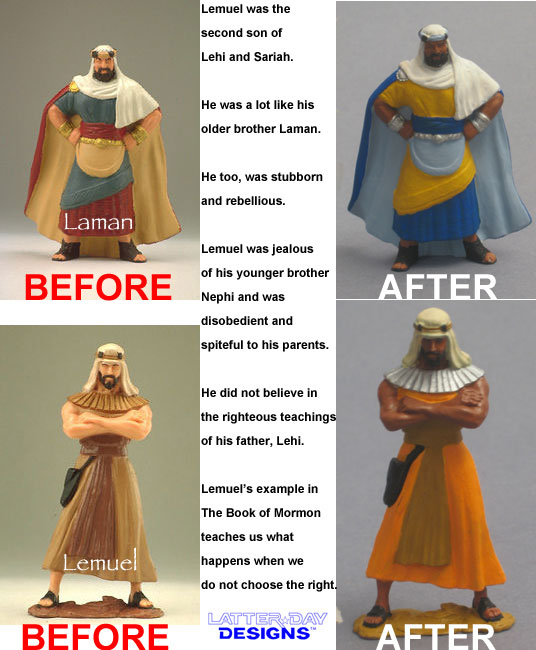
Source: Latter-day Designs
Lemuel’s example in The Book of Mormon teaches us what happens when we do not choose the right.
What happens is you wake up with a permanent tan. That’s no Anglo-American folk belief. It’s 100% Mormon and remains received truth for nearly the same percentage of LDS adherents.
In terms of LDS institutional preferences, let’s call this Exhibit B:
The original headings remained in most English editions until 2004, when Doubleday published the first trade version of the LDS scripture and implemented the editing.
Until this month, the 1981 headings remained in the churchs online version at lds.org. When the church upgraded its website, the Doubleday changes were included online. The former version will continue for now in the printed English versions.
The Mormon church is leaving its historical missteps behind so quietly that they’ve decided to let a gentile book publisher lead the way.
Further reading: You can change chapter headings, but you cannot change history … the only way to remove the racial implications of Book of Mormon teachings is to change the text of the Book of Mormon itself.
butbutbut, the church isn’t racist! just like the 1981 BoM changes, i’m sure this is the work of some rebellious printer who mistranscribed the scripture from what the original intent was.
and, i should clarify, that the church is now correcting these grave errors. decades and decades after the fact.
It’s not the church that’s racist, just it’s members.
And leaders. And founders. And doctrines. lol
Better late than never. It’s not laudable but it’s progress.
You can’t assume that all of the members are racist. That makes YOU biased and closed minded. You’ll find racists in every religion. It all depends on how the person was raised. Just like you were seemingly raised to believe that mormon church is wrong, I was raised to believe it is right. Get over yourself.
No, Mormons aren’t all racist. But if they’re not, it’s because of their own moral instincts, with no help from their religion. Why not skip the church altogether and operate from your moral instincts directly?
Oh, and Anna: Many of us were raised in the church. And if you believe it only because you were raised in it, you should probably realise that if you were born somewhere else, you’d be arguing for some other religion. Think about it.
David, my feelings against racism were PROFOUNDLY impacted by my religion.
Ironically – as it so happens – I first learned it from the book of Mormon.
Stories of Samuel the Lamanite and the people of Ammon – along with all those clearly dark-skinned people in the illustrated children’s Book of Mormon reader – which I listened to almost every Sunday as a kid – from kindergarten to third grade. They basically instilled in me a strong sense that righteousness was not contingent on skin color.
So all this stuff about the Book of Mormon being racist has always baffled me. Because it’s precisely the book that taught me NOT to be racist – before I ever heard of Martin Luther King Jr., or read about the Civil War in school.
Oh, and I don’t suppose that anyone here is going to give a flip that the chapter headings were always mere study aids – and never “scripture” to begin with?
Bruce R. McConkie wrote the chapter headings. Not Mormon. Not Joseph Smith.
Bruce R. McConkie.
Oh, and incidentally – Alma Chapter 11’s heading no longer says “Nephite coinage set forth.”
It now reads:
“The Nephite monetary system is set forth”
Those mischievous Mormons – there they go again removing bad commentary on the scriptures.
Someone needs to put a stop to this.
Seth,
I’m glad they didn’t instill you with the virtues from verses like this one:
“…that they might not be enticing unto my people the Lord God did cause a skin of blackness to come upon them.” 2 Nephi 5:21
Now who said cherry-picking scriptures was a bad idea? 😉
I would like to add that I unfortunately left out a bit of context by only partially citing the verse. Please do check the entire thing.
Either way, your just god returned them to whiteness, therefore removing the “sore cursing” their black skin was (3 Nephi 2:14-15).
None of which has anything to do with what I just wrote. But thanks for that.
“So all this stuff about the Book of Mormon being racist has always baffled me.”
I apologize for not understanding what you may have meant by this, but I took it that you were still baffled, and therefore potentially unaware of why people consider the BoM racist.
In a sense, it still does baffle me. Because the message of the book still doesn’t seem racist to me.
I mean, I do see why people consider it racist. But such a viewpoint seems based to me on a very superficial reading of the book.
King Lamoni was clearly a great and righteous man – and the Book of Mormon unequivocally portrays him as such. I grew up in Sioux Falls, South Dakota in my early years – an overwhelmingly “white” city back in the 1970s and early 1980s. I had almost no exposure to people of any color other than my own. Almost the ONLY exposure I had was through those cheesy “Beginning Readers” renditions of LDS scripture. And I DID NOT get a negative view of dark-skinned people from it.
It was actually positive. That view stayed with me throughout the rest of my life.
It was only when I entered the world of online debate that I LEARNED about why the Book of Mormon is supposedly a “racist” book.
I am convinced that it is not. I can see why a superficial and uncaring view of the book might reach that conclusion – but I do not share it.
Superficial and uncaring. From being in online debate, I’m sure you’re aware of how you just put some very prominent prophets under that banner as well.
Maybe I just care about the wrong things, then? Considering I care when I see blatantly racist remarks in a book of purported scripture? These racist verses have had a bit of an impact on historical LDS doctrine, I think we have different standards for what counts as “superficial”.
When I was a kid, my family used to read the Book of Mormon together as a family. Here’s a map my brother posted that we drew together when I was 5.
I was aware, even as a kid, that God changing peoples’ skin color based on righteousness was an important component of the story. (See the part right around and soon after Christ’s visit.) We didn’t talk about whether or not that was “racist” because who are we mortals to judge whether God’s actions are racist or not? God can do whatever He pleases. After I stopped believing, naturally, the racism of this story theme was so obvious (especially coupled with the priesthood restriction for the lineage of Ham, discussed in the PoGP) that I don’t recall specifically when I noticed it.
So which was it for you, Seth? You didn’t notice the parts of the book where dark skin is a curse until you started discussing the book online? Or was it that the online discussions that clued you in to why people might consider that storyline racist?
It might not seem racist to you, but weren’t those passages precisely why Mormons believed blacks couldn’t be ordained? Do you believe that policy was racist? Did church leaders simply misinterpret those passages for 100+ years?
In 1998, on the 20th anniversary of the 1978 revelation/policy change, a reporter asked President Hinckley about whether there would be any kind of public repudiation about the priesthood ban, similar to how, for example the US Congress apologizes for its past evils (though really, I’m not sure what these apologies do except make Americans feel better about themselves). Hinckley, said: I dont hear any complaint from our black brethren and sisters. I hear only appreciation and gratitude wherever I go…I dont see anything further that we need to do. He was coming back from a trip to Africa, where the Church was growing leaps and bounds.
I’m curious how you interpret this story. I interpret it as Hinckley acting “white,” if not “racist.” But something tells me I’d have to write seven more paragraphs to explain why I see it this way. Perhaps I should ask what your feelings are about the 1978 revelation/policy change — if you actually feel it was a “revelation.”
Yes, I view the 1978 revelation as a “revelation.”
“Did church leaders simply misinterpret those passages for 100+ years?”
Yes.
Chanson, I noticed it was a curse.
But it didn’t occur to me that darker skin meant your were an evil person.
I’m a little confused why revelation has been attributed to the change of a racist policy. I mean, it’s not like God would have said, “Yes, they may now be ordained.” Wouldn’t it have been more like: “Of course they can be ordained. They’ve always been ordainable, you stubborn fools.”…? Wouldn’t coming up with the change on their own rather than attributing it to revelation be better in terms of legitimacy?
I remember talking to that very nice lady from South Africa during the early eighties who insisted that reports about her country were misrepresentations and that we just didn’t get it.
The fact of the matter is that racists are people like us. Nazis are people like us. Communists were people like us.
I can say that because I had the dubious pleasure of meeting all those people and they were very nice indeed. They weren’t monsters. They were people like us and if I had been in their situation, I might have done what they have done.
In their own eyes, the bad guys are the good guys. And nobody ever does anything evil.
The real question is what was it like growing up as a Black child in Utah in 1930, 40, 50, 60 and 70? How did the people who we labeled and excluded experience Mormon culture and society?
Evil or not. Accd. to the BoM: Black skin isn’t enticing. White skin is delightsome. God put a sore cursing on a people by making them black. Once they become more righteous, they became white.
There’s a fairly racist theme at play here whether it said black people were evil or not.
Alan, I don’t think the Priesthood ban was ever “revelation” or even inspired to begin with.
But this misguided policy became so entrenched in the LDS system that it took a full blown revelation to root it out.
I have an quirky take on the racist passages in the Book of Mormon actually. But it’s not something I think will be shared that widely by other Mormons, so I don’t want to ramble on about it if no one is really interested.
Kinda O/T, but has there ever been any LDS church publication (printed anywhere, anytime) that showed an interracial couple? Ever? Seems like a fair question.
That was an interesting video, Chino. That guy needs to give himself permission to do what’s best for him and his family and stop worrying about everything else.
Since I’ve posted a link to that video, I should probably go ahead and drop these links here by way of background for that clip:
Street Prophets: Mormon Like Me: Black Saints, Bigots, and Beck (Margaret Young wrote it, but I get credit for the awesome title)
Nobody Knows: The Untold Story of Interracial Mormon Marriages
Plus an unrelated bonus link:
Segullah: My dad thinks it would be a bad business idea if I ever married a black girl.
Wow, Chino. That story about Keori’s brother is just heart breaking. I wish somebody would interview him. Utah Mormons need to hear from people like him.
He might even have a case against the school district that exposed him to so much hostility. That seems to be a civil rights violation.
The Bush administration, of course, did not prosecute that but Tom Perez will.
Seth,
Actually, I’m pretty interested in hearing your take on the racist passages in the BoM.
It’s not an LDS church publication but the mormons series on pbs some years back had an inter-racial couple. Again, I know it’s not official. I believe they were standing in front of the temple, after (seemingly) just having been married there.
Yes, those images ought to help transform what Mormons consider normal, Aerin.
But Seth, this isn’t about you. It’s not about how you, as a privileged white boy in a racist white patriarchal society, came to view race without the challenge or blessing of having to interact with real human beings of other races; it’s about how racist depictions teach the people in those depictions to view themselves. (Though the fact that you think it is somehow about you is an indication of just how racist the whole system is.)
You complained recently that you resented having you faith “reduced to a transient political issue” (meaning Prop 8). So imagine how it would feel to have something even more intrinsic to who you are–the color of your skin, what you see when you glance at your torso in the shower, or raise your hand to your face, or look in the mirror–reduced to a curse.
Even if it’s a curse for eating with the wrong hand during dinner as opposed to a curse for immorality and evil, the fact that someone is told that their skin is a CURSE is racist and wrong. It justifies and perpetuates the racist view that there’s a default, “pure, delightsome” skin color and affirms, quite explicitly, that other skin colors are impure and revolting.
That’s racist. No matter what you managed to extract from the BOM that helped you overlook that and feel good about it and yourself, the fact remains that its basic approach to race is racist.
Actually Holly, it is about me.
OK, Seth, you’re right: It’s about the way you can’t get beyond your own perspective.
it shouldn’t be, but I can’t argue that ultimately, you make sure it’s about you.
openminded, I’ve cut and pasted my own words from a different conversation I had on this topic so I wouldn’t have to reinvent the wheel. Here goes….
My own view of the book of Mormon is that read as a whole it is not particularly racist.
I do personally feel the author Nephi himself was racist (hardly a surprising thing for a person who lived around 600 BC they were all racists back then to some degree or other – when they thought about it at all). My own feeling is that he simply observed his wicked brothers intermingling with the local native population (something forbidden by the Law of Moses for any Israelite), and when their children had darker skin as a result he simply took it as a sign of Gods displeasure and wrote the lines quoted most often in these discussions. Most of the “racist” scripture cites originate from Nephi (and one from his younger brother Jacob) (1 Nephi 11:8, 13; 12:23; 13:15; 2 Nephi 5:21; 30:6; Jacob 3:8).
But by the time we hit the Book of Mosiah, it seems clear to me that few if any racial distinctions remained by that point. Both Lamanites and Nephites seem to have intermingled so thoroughly with the indigenous populations as to be indistinguishable from each other on basis of skin color. Part of my basis for concluding this is simple population genetics based in my belief that both Nephites and Lamanites intermingled with the natives, and part of it is based on my reading of Amulek’s speech to the people of Ammonihah – where he seems to feel it necessary to declare himself a “descendant of Nephi” – which if skin color distinctions were actually still in existence would be an entirely unnecessary comment.
It is true that Alma speaks of a mark distinguishing a wicked group from the righteous, and references the old skin cures (Alma 3:6) (or Mormon – I should say – since he’s the one who is the authorial voice in Alma). But the mark in this case does not appear to be related to skin color, but rather one the people put on themselves. Mormon 5:15 speaks as the descendants of the Lamanites being “dark, filthy and loathsome”, but this appears to be more a commentary on their idolatry and wickedness than on their skin color. The only really problematic passage I find in the Book of Mormon is actually 3 Nephi 2:15 – which seems to reinforce the skin-righteousness connection by declaring that Lamanites who became righteous received whiter skin.
When reading any book after Jacob in the Book of Mormon, it needs to be kept firmly in mind that the author is Mormon the man who took all the records and history and abridged and condensed it down to the Book of Mormon. So it always has to be kept in mind how he would be viewing things. I view the passage in 3 Nephi as possibly merely an instance of Mormon extemporaneously attempting to harmonize the record with Nephi after the fact. But this passage gives us little to go on in understanding the true nature of Nephite racial views.
I personally think its a mere matter of population demographics and genetics to reach the conclusion that Lamanites and Nephites wouldnt have even had skin color differences by the time the events in 3 Nephi happened.
However, it is possible that Nephite society simply valued light-colored skin in the same way the Japanese currently do. Japanese consider lighter skin to be a mark of beauty and dont like looking tan (unlike we Americans). Yet Japanese are all of the same race. So its not so much a racist quirk as a vanity quirk (or defect). Nephite society may have been similar to this by the time of 3 Nephi. But this is admittedly pure speculation on my part.
The point is, if you actually view this as a real historical record (as faithful Mormons do), then the racist character of the ENTIRE book is far from clear.
Consider also, the countless stories in Alma of the Lamanites proving more righteous and praisworthy than the Nephites. Helaman even has an account of a Lamanite prophet condemning the evil Nephites from the city walls. At that point in history, Mormon praises the Lamanites extensively as morally superior to the degenerate Nephites – and this BEFORE any skin color changes are mentioned. This is not a narrative of racial condemnation.
If the Lamanites were darker skinned than the Nephites at this point (and I dont really think they were), and if the Book of Mormon is a bona fide historical document (which I think it is) it would probably stand as one of the most racially PROGRESSIVE books of its time period (keep in mind that other writings of that time period were, when they spoke of race at all, unapologetically racist and xenophobic in nature).
Understandable. When I was a biblical inerrantist, I would excuse such things as Exodus 20:20 and the Leviticus statement about gays as culturally-specific to that point in history. I think degrading an author’s thoughts on god puts into question any statement made about god by that person (what other cultural truisms might we be missing? Truisms about morality, views on deity, etc. could falsely influence the mix as much as racism did).
As for the view that this is a product of the 19th century, I would compare Abraham Lincoln’s views to Smith’s: progressively wanting an end to slavery while still upholding the view that black people are inferior in a few ways. Just seems like that 19th-century line of thought bled into the text.
Seems more reasonable to me too, but I haven’t invested a lot of my life into trying to believe in and devoutly follow your religion. I can accept a more reasonable view and not worry about the pain and suffering of losing faith in Mormonism.
Yes, I don’t pretend that Joseph Smith was any sort of patron saint of racial equality. He wasn’t. But he wasn’t really comparatively that bad for his day either. The comparison to Abraham Lincoln seems apt (except that Smith was never in the position to exercise the sort of influence Lincoln did). Both men had reservations about ending slavery. Neither were really abolitionists (who were a fringe movement of society at best), and both would have been repulsed by the first impression notion of interracial marriage I think (to be fair – so would most white abolitionists of the day).
But Joseph was fairly progressive for his time. He had some statements in favor of the status quo on occasion – but most of these boil down to “look, we Mormons aren’t going to interfere with your slaves – so please don’t shoot us.” When you add in the stuff about Elijah Abel being ordained to the Seventy, I don’t think the legacy of Mormon racism can really be laid at Smith’s door – passages in the Book of Mormon notwithstanding. I attribute the ban mostly to Brigham Young making a policy decision, and then his subordinates running with it. Over time, the need to justify the ban arose – at which point, figures like Joseph Fielding Smith and his follower Bruce R. McConkie started borrowing Protestant racist biblical arguments in an attempt to explain or justify the ban. As is often the case, the attempts to justify were worse than the original problem.
Eventually the sheer administrative problem of hopelessly racially mixed areas like Brazil made the ban impossible to enforce and it became apparent to most of the top leadership that it needed to end. Once there was enough popular support for ending it among the leadership, I feel God responded and gave them the revelation. Until that point, I believe that God pretty-much left us to our errors in judgment. Ask and ye shall receive. But if you don’t ask…
I do think Nephi was a product of his time – and misguided in the ways we would expect a person of that time to be misguided. God doesn’t “wipe the hard drive” whenever he calls a prophet. He leaves the prophet’s agency intact, and will not swoop in to override the prophet’s brain. I firmly believe this.
Scripture is ALWAYS to be read with the possibility of the presence of a flawed mortal author firmly in mind. I have read the Book of Mormon this way for some time now. For instance, whenever reading glowing passages about characters like Captain Moroni, or the nature of Nephite civic duty – I always have firmly in mind that I’m getting this perspective from a GENERAL who has been leading armies since adolescence (Mormon).
That’s a pretty big lens of bias coloring your worldview. And I expect it to be present in the Book of Mormon.
As to whether this allows you to trust the Book of Mormon?
I would simply respond – trust it for what?
I enjoy more liberal strains of thought such as that. They held me back from agnosticism for quite some time. I still hover somewhat back-and-forth. As for your argument about each character holding a particular bias, I’d argue that Smith’s bias was largely behind each character–his thoughts on what, for instance, a general would do or say or believe.
As for your question: trust it to be holdable to the truth standards implied by Moroni’s promise.
For instance, since Moroni promised “these words” to be true (referring to all the words in the BoM, I’m assuming), I would confront a passage such as the racist ones and ask, “is it true that God considered black skin to be a curse that could be lifted with righteousness?” and take a relatively face-value approach since Moroni specifically mentioned these particular words (the ones that appeared in the BoM–not the ones that excuse the presence of particular verses).
I keep open the POSSIBILITY that Smith’s own biases crept into the text of the Book of Mormon. But I avoided going there for this particular discussion because I didn’t think it was necessary to go there. Besides, people are always arguing whether Joseph Smith shows up personally in the Book of Mormon text. Fewer people are arguing about whether Nephi, Jacob, Mormon, and Moroni are showing up in the text.
But I definitely keep it as an option. I think it is at least quite likely in the use of King James English in the Book of Mormon (the accepted way of speaking religiously in Smith’s day).
I just see it as more likely. Plus, I’m not sure how aptly one could argue for specific personalities emerging from the separate authors. Ever come across any good articles on textual comparison among each cited author? I’m sure someone has at least thought of it.
Was also hoping to see if there was more room in Moroni’s promise than I gave it credit for, in your view. We throw in words such as “historical document”, but I wonder if that’s synonymous with what Moroni meant by “true”.
I don’t know enough about Joseph Smith to assess the historical merit of his position regarding race but I can see that such an argument may be plausible.
What I do find troubling is that attitudes that might have been progressive a hundred years ago apparently atrophied and validated racism in the 20th century.
It seems to me that latter-day prophesy should speed along progress instead of entrenching discrimination. Talking to god should make you smarter and more open-minded, not hateful and bigoted.
The BoM is rather ambivalent and confused about race/skin color. Dark skin is a curse (or a sign of the curse), but the righteous aren’t always the white guys. Sometimes the dark guys are the good guys. Racist Mormons even had to argue past some of these passages to justify their racism.
But if it’s a curse, then doesn’t that make God unjust for “afflicting” innocent people with dark skin?
Anyway, I have high standards. God should have created scripture that would have been unequivocally against racism.
I think the Book of Mormon is rather ambivalent about what the word “curse” even means.
Sometimes it seems to have a racial component – though it’s never clear that the Book of Mormon is flat-out stating that darker skin is a sign of moral content of a person. Other times the curse is mentioned in contexts where clearly no racial meaning is meant at all (like the Amalekites marking themselves and incurring the curse – with no skin change).
What does the word “curse” even mean in the Book of Mormon? It could just be a mark of some past wrong – but not ongoing ones.
Redefining words is a common tactic in apologetics.
Taking words at only the meaning that suits you is a common tactic on the Internet in general.
Besides, we don’t redefine them. We simply look for the full range of meaning in the word, research the most likely historical use, and then keep that meaning in mind.
This tends to irritate people who depend upon the simplistic for the force of their own arguments.
I had a Lamanite (Navajo) foster brother and sister for a few years, back during my Arizona period (’67-’76). This is the Mormonism that I remember hearing around the house:
Wow, this is making me nostalgic, bringing back some real powerful memories, i.e., the post that got me banned at By Common Consent back in May: Where have all the Lamanites gone?
Just think, if I’d simply waited until August to comment under this later BCC post, we’d probably still be on speaking terms: Reconciling the Indian Placement Program
Actually, I think I’m gonna nominate that second post for a Brodie of some kind.
We simply look for the full range of meaning in the word, research the most likely historical use meaning most favourable to our point of view, and then keep that meaning in mind.
FTFY.
Where is the
striketag around here?We simply look for the full range of meaning in the word, research the
most likely historical usemeaning most favourable to our point of view, and then keep that meaning in mind.FTFY.
This tends to irritate people who depend upon the simplistic for the force of their own arguments.
If you don’t believe me, look at your own comment 41. You’re falling all over yourself trying to redefine ‘curse’ in a way that doesn’t mean ‘curse’. It’s really obvious.
I see a pretty easily defined word for curse, when it came for God cursing the unrighteous with black skin.
Considering it was done as a punishment, then it’s the same type of curse we thought it was in the first place (when we took it at face-value).
Oh, but openminded, we’re being simplistic, at least according to Seth’s definition:
simplistic (adj.) Disagrees with Seth.
Will you tell the dictionary people, or shall I?
I agreed with his methods of determining the meaning of a word.
Besides, ever heard of Winston Churchill and the school of fags? Google it. Language is as mendable as Seth makes it out to be. (also, remember how God repented in the OT? A lot of atheists took it to mean the “simplistic” use of it rather than the actual “historical” use)
Words can mean many things, but apologists are selective about their semantics in a way that always seems to work to their advantage, no matter what.
That’s what they do, Daniel, but I don’t think that Seth is an apologist. An apologist will do anything to give faith a chance. If there is the slightest ambiguity, the apologist will make a bee line for it and consider his faith reasonable.
By contrast, Seth is wrestling with the language of the Book of Mormon to obtain an ethically responsible reading of the text.
Since we have to assume that Mormonism will be around for a long time, that is a valuable effort.
Why? Why is it valuable to try to define your way around the inherent racism in the LDS Church’s defining text so that you can feel okay about it?
I’m with Daniel: Seth’s is an enterprise designed to make people feel good about the racism they’ve grown up with so they don’t have to admit it.
I find it impossible to believe that anyone could think the Book of Mormon is rather ambivalent about what the word curse even means–unless they’re using “think” to mean “hope.”
The examples listed below, chosen at random from a search for the word “curse” in the BOM on the LDS scripture page, show that “to curse” in the BOM adheres pretty closely to a standard dictionary definition of “to call upon supernatural powers to bring harm to someone or something,” while the noun form is the calling upon or the resulting harm.
Saying otherwise is not an appeal to but an avoidance of “the most likely historical use.”
2 Nephi 5:21
And he had caused the cursing to come upon them, yea, even a sore cursing, because of their iniquity. For behold, they had hardened their hearts against him, that they had become like unto a flint; wherefore, as they were white, and exceedingly fair and delightsome, that they might not be enticing unto my people the Lord God did cause a skin of blackness to come upon them.
2 Nephi 5:23
And cursed shall be the seed of him that mixeth with their seed; for they shall be cursed even with the same cursing. And the Lord spake it, and it was done.
2 Nephi 1:22
That ye may not be cursed with a sore cursing; and also, that ye may not incur the displeasure of a just God upon you, unto the destruction, yea, the eternal destruction of both soul and body.
Alma 3:9
And it came to pass that whosoever did mingle his seed with that of the Lamanites did bring the same curse upon his seed.
Helaman 13:17
And behold, a curse shall come upon the land, saith the Lord of Hosts, because of the peoples sake who are upon the land, yea, because of their wickedness and their abominations.
Ether 14:1
And now there began to be a great curse upon all the land because of the iniquity of the people, in which, if a man should lay his tool or his sword upon his shelf, or upon the place whither he would keep it, behold, upon the morrow, he could not find it, so great was the curse upon the land.
a) The Mormon Church will stick around for a long time.
b) Therefore, a lot of children will grow up in the Mormon church.
c) If children grow up in the Mormon Church, they need to learn that racism is bad.
d) Seth’s approach performs that function.
Therefore Seth and his buddies at the bloggernacle add value to Mormonism and to the life of those of us who have to continue to live with Mormons.
No it doesn’t, Hellmut. It teaches people that racism isn’t racism if you can find a way to wiggle out of acknowledging it, and that what matters in stereotypes and offensive depictions is not how they affect those described by the stereotypes or offensive depictions, but those who AREN’T described.
In other words, to apply Seth’s logic about the BOM to the story of the Garden of Eden, how the sexist depiction of Eve affects women isn’t important; what matters is how it affects men. And the word “curse” thrown at Eve isn’t really a curse; it’s…. a site of ambivalence. Women are actually blessed by childbirth, and the whole submission thing? It just keeps life running smoothly.
I mean, after how many decades/centuries of slapping Seth’s rhetoric on the story of the fall, we ALL know that it’s not REALLY a curse, right? And look how well that works for fostering meaningful discourse about the status of women in religion.
Holly, your critique would have a lot more credibility if I hadn’t called Nephi racist in an earlier comment (and implied that Mormon might have been too). Oh, and I said Brigham Young was racist too – and even Joseph Smith to some extent.
Or did you just miss that part?
Seth, The fact that you are forced to acknowledge the grossest racism when you’re confronted with it doesn’t compensate significantly for your attempts to whitewash its somewhat subtler manifestations.
Actually Joseph Smith was a subtle case of racism under what I was saying earlier. So was Mormon.
Sure, as part of a larger attempt to whitewash an overall racist ideology and culture.
“OK, there are little bits of racism in the Book of Mormon, but really, taken as a whole? It’s actually really enlightened!”
Sure, compared to lynchings and slavery. Compared to genuine equality and respect? Not so much.
Well Holly, I guess everyone can look at what I wrote and make up their own mind about that. I doubt me talking to you about this is going to serve any useful purpose.
OK, Seth, if the idea of race you’re trying to defend in the BOM is the best you can do when it comes to condemning racism, I’ll give you credit for at least trying. But as Jonathan Blake said, some of us have higher standards–for ourselves, our ideas of the divine and our sacred texts.
Jonathan wrote:
“Anyway, I have high standards. God should have created scripture that would have been unequivocally against racism.”
I disagree.
Racism is a symptom of a deeper human problem – not a core problem in its own right.
I would prefer that God address in his scriptures the deeper core human problems that cause racism. Such as selfishness, lack of charity, and pride. Which I believe the Book of Mormon and Bible do.
I disagree. I think that the tendency to mentally flatten “other” groups into stereotypes is the core human limitation on our biggest human strength (empathy). It is more invisible (hence harder to root out) than pure selfishness. See my post on racism.
Racism is merely a subset of that flattening impulse though. As such, it reflects a symptom and not a core problem. So your clarification is helpful Chanson, but I think you are essentially making the point I was trying to make.
OK, but if God existed and were omniscient, couldn’t He have given us scripture to clarify and counteract this human tendency, instead of just going with the flow?
He did. Scriptures on charity, empathy, love, service, etc. God addressed his words to the core problems of the human condition. He left their application to us.
No, racism isn’t just the flattening impulse. It’s also about biopolitcs: e.g. the “one-drop rule” in the early countings of black people for the US census or the fact that Mormon literature today still features no interracial couples. Or it’s about how the Church supports Mexican immigrants ecclesiastically, but paradoxically cannot be vocal or support immigrant rights in the public sphere except to the extent of calling for things like “charity, empathy, love, service” (which basically amounts to giving a homeless person money without addressing the issue of homelessness itself).
Same goes with gay rights. In the debate, the Church calls for “empathy, love, understanding, patience.” But it says this after Prop 8. I’m sure you like maintaining a difference between race-based civil rights and gay rights when it comes to the Church’s positions. So, it would seem sensible for you to not make all of the “-isms” (racism, sexism, heterosexism, ableism, classism) “subsets” of a “core” issue.
It may also be biopolitics, but biopolitics itself is a symptom as well. I still wouldn’t call it a core issue.
And the mere fact that the Church still does stuff like Prop 8 after calling for “love” or whatever else doesn’t really establish anything in this argument that I’m seeing.
And I don’t have any problem making sexism, racism, heterosexism, and such subsets of the same core issue. Should I?
I agree with you, Holly, that hypocrisy is the problem of that approach, not so much of the people who re trying to reconceptualize Mormonism in humane and ethical terms but for their audience, that means our children.
It doesn’t get us there but I still think that it is a good faith effort that does make a difference.
The good thing about hypocrisy is that, by definition, it constitutes a contradiction and thus provides an opportunity for criticism, which I will be happy to exploit.
The narrow point was just that Seth is not an apologist and that there is value in his work.
Hellmut@73
i disagree with you on both points. There is little value and great harm in his approach.
Seth@70
while he goes on and on about what a jealous, vengeful, judgmental being he is, prone to playing favorites, killing people on a whim, and cursing his less-favored children with dark skin because that makes them ugly to his more-favord children, which is what all parents want.
Not surprising that we do such a crappy job of having empathy and compassion with that guy setting the example for moral behavior.
Seth @64
Seth is an apologist, Hellmut. The reason he had to back off from the discussion with me is because he couldn’t hold his point. The “useful purpose” that could be served is that he might actually learn something and have a clearer idea of what’s really going on in very problematic but nonetheless important text. But he’s not interested in truth or accuracy. He’s interested in protecting LDS church texts from criticism. That makes him an apologist.
I guess I can agree that believing that racism is bad and undertaking mental gymnastics to reconcile that belief with racist texts is certainly an improvement over simply accepting the racism in them. Trying to reconcile ancient and 19th century texts with 21st century humanistic values seems much better than simply clinging to the values that actually informed the texts (though it’s also much less coherent or consistent). I sympathize with the effort, even though (or maybe because) it seems likely to be futile in the end. (And I’ve been there myself.)
OTOH, I think that Holly is right and these attempts fail to grapple with the notion of “privilege.”
Black people had to wait for the priesthood and temple blessings until white people were ready to give them to them. There was, of course, never any question of white people being the ones who had to wait.
It’s OK if the leaders chosen by God are a little (or sometimes a lot) racist and even if some racism gets into the scriptures, because that doesn’t necessarily make white believers think that dark-skinned people are inferior. Any effects that may have on actual dark-skinned people are, of course, incidental.
In the end, the Mormon god doesn’t despise dark-skinned people (anymore). It’s just that when there is any sort of racial conflict, it’s always the needs of white people that come first. Dark-skinned people’s needs are met in terms of how they meet white people’s needs.
Yes to what Kuri says in 75.
Seth’s refusal to confront the issue of privilege (which is a manifestation of privilege–those who don’t have it figure out a little more quickly what it is) is why I say he’s not interested in truth or accuracy but in devising a position that always privileges his own views at the expense of anyone else–even those more acutely affected by an issue. Think of his attitude about Prop 8, and his insistence that what really matters in the attempts to defeat it is his comfort with the tactics.
Update: Dark-skinned Laman and Lemuel have now been removed from the Latter-day Designs website.
This comment at PostMormon.org cracked me up:
😀
Scratch one for the DAMU, Chino. Congratulations!
“Power concedes nothing without a demand. It never has and it never will,” Frederick Douglas.